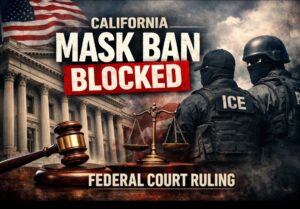
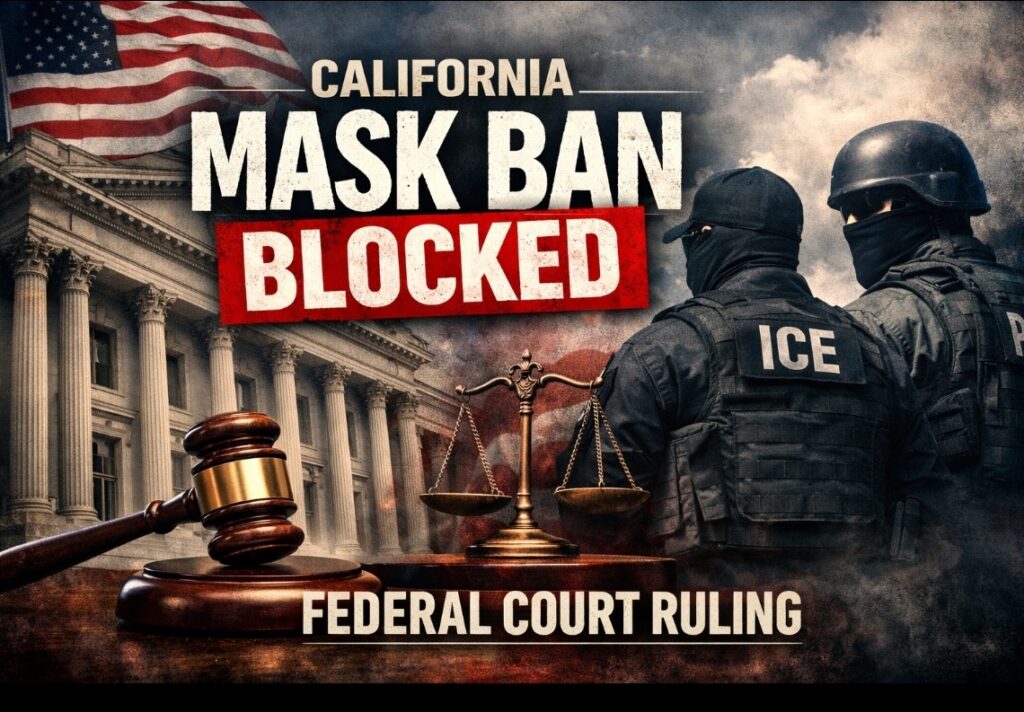
A federal judge has blocked a key portion of a California law aimed at forcing federal immigration agents to remove face coverings during enforcement operations, ruling that the measure unlawfully interferes with federal authority and endangers officer safety.
As reported by Fox News, U.S. District Judge Christina A. Snyder issued a preliminary injunction halting enforcement of the mask-ban provision of California’s so-called “No Secret Police Act.” The law was set to take effect in January and was championed by progressive lawmakers hostile to federal immigration enforcement.
Judge Snyder concluded that California’s attempt to prohibit federal officers from wearing masks during operations likely violates the Supremacy Clause of the U.S. Constitution. The statute, she found, impermissibly targets federal immigration agents while carving out exemptions for certain state and local law enforcement officers—an unequal standard that intrudes on federal responsibilities.

Importantly, the court’s ruling was narrower than a total invalidation of the law. While the judge blocked the provision banning face coverings for federal officers, she allowed a separate requirement to stand that mandates visible identification for non-uniformed officers, so long as it does not conflict with federal operational needs.
The injunction applies specifically to the mask ban and has been stayed through February 19, 2026, giving California time to appeal the decision. Until then, ICE agents operating in the state may continue using face coverings when necessary to protect their identities and families.
The Department of Justice argued that anonymity is often essential for officer safety, particularly amid a documented rise in doxxing, threats, and harassment directed at ICE personnel. Agents frequently target violent offenders, human traffickers, and transnational criminal organizations—work that places them at heightened personal risk.
California officials defended the law as a matter of “transparency” and “accountability,” rhetoric commonly used by left-wing activists seeking to undermine immigration enforcement. Critics counter that the true aim is intimidation: exposing agents to public retaliation in order to discourage lawful arrests.
Conservative leaders and law enforcement advocates praised the injunction, warning that California’s political leadership continues to place ideology above public safety. By attempting to single out federal agents for hostile treatment, they argue, the state is effectively siding with criminal networks and illegal aliens over those sworn to uphold the law.
From a biblical worldview, civil government is ordained to restrain evil and protect those who carry out justice. Scripture teaches that governing authorities are “God’s servants” tasked with punishing wrongdoing (Romans 13:3–4). Policies that knowingly expose law enforcement officers to danger invert this moral responsibility and erode respect for lawful authority.
While the legal battle is not yet over, the ruling represents a significant check on California’s effort to obstruct immigration enforcement. It also underscores the growing constitutional conflict between federal authority and activist state governments determined to resist the enforcement of national law at nearly any cost.