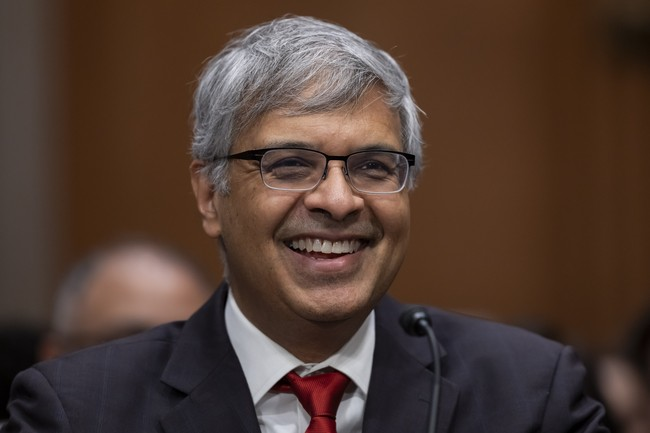
President Donald Trump has appointed Dr. Jay Bhattacharya, the director of the National Institutes of Health (NIH), to serve as the acting director of the Centers for Disease Control and Prevention (CDC), according multiple reports.
Bhattacharya, a Stanford-trained physician-scientist and health economist known for his criticism of federal pandemic lockdowns and his role as a co-author of the Great Barrington Declaration, will lead both the NIH and the CDC until the White House nominates a permanent CDC director, subject to Senate confirmation.
The leadership change is part of broader personnel shifts within the Department of Health and Human Services (HHS). Jim O’Neill, who had been serving as acting CDC director, will leave that role and is expected to be nominated as the next director of the National Science Foundation.

The CDC has experienced a series of rapid leadership changes over the past year, with at least two previous directors departing under Republican administrations. Prior to O’Neill’s tenure, Susan Monarez, a microbiologist who briefly led the CDC, was removed last year amid disputes over vaccine policy direction and scientific oversight.
Supporters of Bhattacharya’s appointment within conservative and health policy circles have hailed his scholarly critique of sweeping public health mandates and centralization of decision-making during the COVID-19 pandemic. His academic work emphasizes targeted protection of the vulnerable and minimizing economic and social disruption — principles that resonate with the Trump administration’s “Make America Healthy Again” agenda.
However, some public health experts and former CDC officials have expressed concern about the practicality of overseeing two of the nation’s foremost health agencies concurrently, warning that such consolidation could lead to operational strains at agencies already grappling with workforce morale and mission clarity.
In his Senate testimony earlier this year, Bhattacharya reiterated support for traditional childhood vaccination programs — including measles immunization — while arguing that there is no credible evidence linking vaccines to autism. This stance seeks to balance scientific consensus with his broader critique of regulatory overreach.
As acting CDC director, Bhattacharya’s tenure is expected to be temporary, extending only until a permanent nominee is selected and confirmed by the Senate — a process likely to unfold over the coming months.
This appointment represents a significant shift in federal public health leadership at a time when trust in the CDC remains a pivotal issue for American families and policymakers alike.