An online prediction market allowing users to wager money on whether a nuclear weapon would detonate somewhere on Earth has been quietly removed following widespread backlash online.
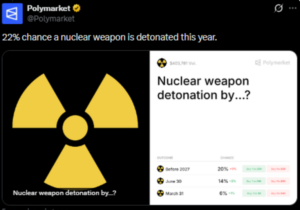
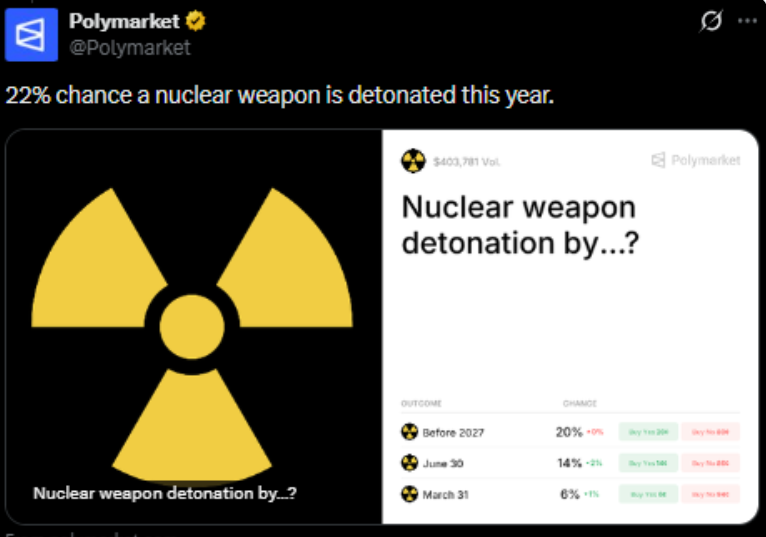
As reported by Not the Bee, the cryptocurrency-based prediction platform Polymarket recently hosted a market in which traders could buy and sell shares based on whether a nuclear detonation would occur before specific dates.
The market offered several timelines—such as by March 31, June 30, or before the end of 2026. Traders who purchased “yes” shares would receive payouts if any nuclear detonation occurred anywhere in the world, including a wartime strike, a weapons test, or even an accidental explosion.

By the time the market disappeared from the platform, it had already generated more than $650,000 in trading volume, demonstrating how much attention—and speculation—it had attracted among users.
But critics quickly raised moral and ethical concerns about turning catastrophic global events into gambling opportunities. The possibility that people could financially benefit from a devastating nuclear event struck many observers as deeply troubling.
In recent days, the market drew additional scrutiny after unusual trading activity was reported following the death of Iranian Supreme Leader Ali Khamenei during regional conflict involving U.S. and Israeli strikes on Iran. Although those attacks were not nuclear, the heightened tensions appeared to drive renewed speculation on the platform.
Prediction markets like Polymarket operate by allowing users to buy shares representing the likelihood of real-world events. Share prices fluctuate as traders place bets, effectively creating a crowdsourced probability estimate. If the predicted event occurs, winning shares pay out a fixed value, typically $1 per share.
While supporters argue that such markets can provide useful signals about public expectations, critics say wagering on disasters or violent events raises serious ethical questions—particularly when those events involve mass casualties or geopolitical instability.
Polymarket appears to have removed the nuclear detonation market without public explanation. The page now simply states that the event has been archived, and it remains unclear whether traders who placed bets will receive refunds.
The controversy highlights the growing influence—and potential pitfalls—of decentralized betting platforms operating in largely unregulated digital spaces. As financial speculation increasingly intersects with global crises, critics warn that markets built on profit incentives may encourage people to treat even the gravest threats to human life as little more than tradable assets.
For many observers, the episode underscores a deeper cultural concern: when catastrophic violence becomes just another line item on a betting board, it reveals how easily modern technology can detach profit-seeking from moral responsibility.