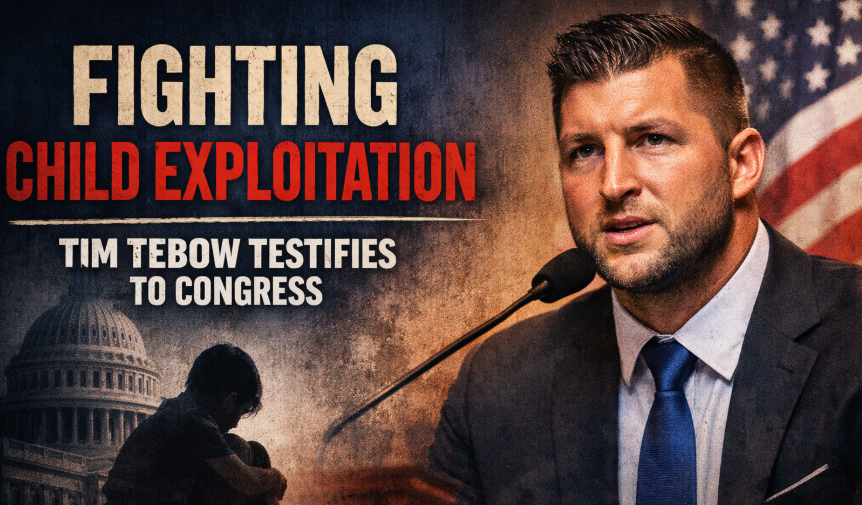
Former NFL quarterback and outspoken Christian advocate Tim Tebow appeared before Congress this week to deliver a powerful testimony about the global crisis of child sexual exploitation and the proliferation of child sexual abuse material (CSAM).
As reported by Evangelical Dark Web, Tebow spoke emotionally about the devastating impact that exploitation has on children and the urgent need for lawmakers and law enforcement to confront the expanding digital networks that enable abuse.
Tebow has spent years working against human trafficking and child exploitation through the Tim Tebow Foundation, which partners with law enforcement and investigative groups to identify victims and help bring perpetrators to justice. During his testimony, Tebow emphasized that every image or video of abuse represents a real child whose suffering is repeated each time the material is viewed or shared.

He told lawmakers that the scale of the problem is staggering. Technology has dramatically increased the reach and distribution of exploitative content, creating a global pipeline where predators can produce, distribute, and consume abuse material with unprecedented ease.
The former athlete also stressed that fighting CSAM requires coordinated action across governments, tech companies, and law enforcement agencies. Tebow argued that stronger investigative tools and greater accountability for platforms are necessary to identify perpetrators and rescue victims.
Tebow framed the issue in moral terms, describing the exploitation of children as a profound evil that demands a unified response. For many Christian advocates, protecting children represents a core moral responsibility grounded in the biblical call to defend the innocent and vulnerable.
However, Tebow’s advocacy on the issue has also intersected with controversy over how abuse statistics are interpreted. In May 2025, Tebow said on a podcast that middle-aged white men were the primary demographic responsible for child sexual abuse. Critics quickly challenged the claim, arguing that the statement confused statistics related to CSAM production and possession with broader child abuse data.
Journalist Megan Basham addressed the claim in a May 27, 2025 post on X, pointing to 2022 National Child Abuse and Neglect Data System (NCANDS) figures showing that per-capita victimization rates were highest among American Indian and Alaska Native children at 14.3 per 1,000 and African American children at 12.1 per 1,000, compared with 6.6 per 1,000 among white children.
Following the criticism, Tebow clarified that his remarks were intended to reference individuals convicted of producing or distributing CSAM rather than all child abusers. According to U.S. Sentencing Commission data from 2023, roughly 77.1 percent of those convicted of possessing or distributing CSAM were white, while 2021 data showed about 75.2 percent of those convicted of producing such material were white. Because whites make up roughly 60 percent of the U.S. population, the numbers reflect a modest overrepresentation in absolute convictions rather than the broader dynamics of child abuse across all contexts.
The debate highlights an ongoing tension in analyzing abuse data: the difference between absolute conviction numbers and per-capita victimization rates. Reports from the National Center for Missing and Exploited Children (NCMEC) also indicate that biological fathers are the most commonly identified offenders in victim series cases, underscoring the tragic reality that many victims are harmed by people within their own homes.
Despite disputes over statistics, Tebow’s testimony focused primarily on the urgent need to rescue victims and dismantle the systems enabling exploitation. Advocates across the political spectrum increasingly agree that the scale of CSAM distribution online has reached alarming levels.
For many Christian leaders and activists, the issue ultimately comes down to moral clarity. In a culture often fractured by politics and ideology, the protection of children remains one area where decisive action and accountability are urgently needed.