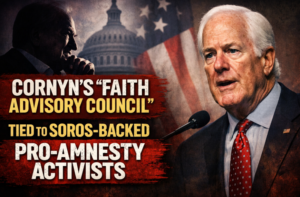

Sen. John Cornyn (R-TX) has launched a new “Faith Advisory Council” aimed at strengthening his outreach to evangelical voters, but the initiative is already drawing scrutiny after several of its members were linked to a George Soros-funded immigration advocacy network.
As reported by Conservative Playbook, the council was announced on March 10 as Cornyn prepares for a Republican primary runoff against Texas Attorney General Ken Paxton, a high-stakes contest that could reshape the direction of the state’s conservative movement.
The advisory group includes several well-known Christian leaders, among them Dr. Jack Graham, pastor and author Max Lucado, and Dr. Gus Reyes. According to the report, all three have been affiliated with the Evangelical Immigration Table (EIT), an advocacy coalition that promotes sweeping immigration reforms, including expanded family-based immigration—often referred to as chain migration—and a pathway to citizenship for those in the country illegally.

The Evangelical Immigration Table operates as a project of the National Immigration Forum, a policy organization that has received significant funding from the Open Society Foundations, founded by billionaire George Soros. Critics argue that the funding structure has allowed pro-mass immigration messaging to be promoted within evangelical communities under the language of faith-based compassion.
Graham and Lucado have also signed the Evangelical Immigration Table’s “Evangelical Statement of Principles for Immigration Reform,” a document calling for policy changes that include legal status for illegal immigrants and broader immigration pathways.
Supporters of stronger border enforcement say these affiliations raise legitimate concerns about the direction of Cornyn’s counsel on immigration policy. The issue carries particular weight in Texas, where border security and the rule of law remain central concerns for many voters.
The report also notes that Ali Noorani, former head of the National Immigration Forum, publicly praised Cornyn in 2021 for sponsoring legislation that included amnesty provisions. Noorani described the move as a positive step toward broader immigration reform.
Cornyn’s campaign framed the advisory council as an effort to seek moral and spiritual counsel in challenging times. In a statement announcing the initiative, the campaign said that principled leadership requires seeking wisdom from trusted voices when confronting the nation’s complex issues.
Yet critics on the right argue that the choice of advisers matters deeply, particularly for voters who view the ongoing border crisis as both a national security threat and a test of government accountability.
The controversy comes as Cornyn faces Paxton in a May runoff after neither candidate secured a majority in the Republican primary. Paxton, who has been closely aligned with former President Donald Trump’s border security agenda, has emphasized enforcement and the restoration of immigration law.
For many conservative Christians, the debate touches on deeper questions about stewardship, national sovereignty, and the proper role of government. Scripture commands believers to practice compassion and justice, but it also affirms the importance of lawful order and wise governance. As the campaign unfolds, voters will likely weigh whether Cornyn’s advisory circle reflects those principles—or undermines them.