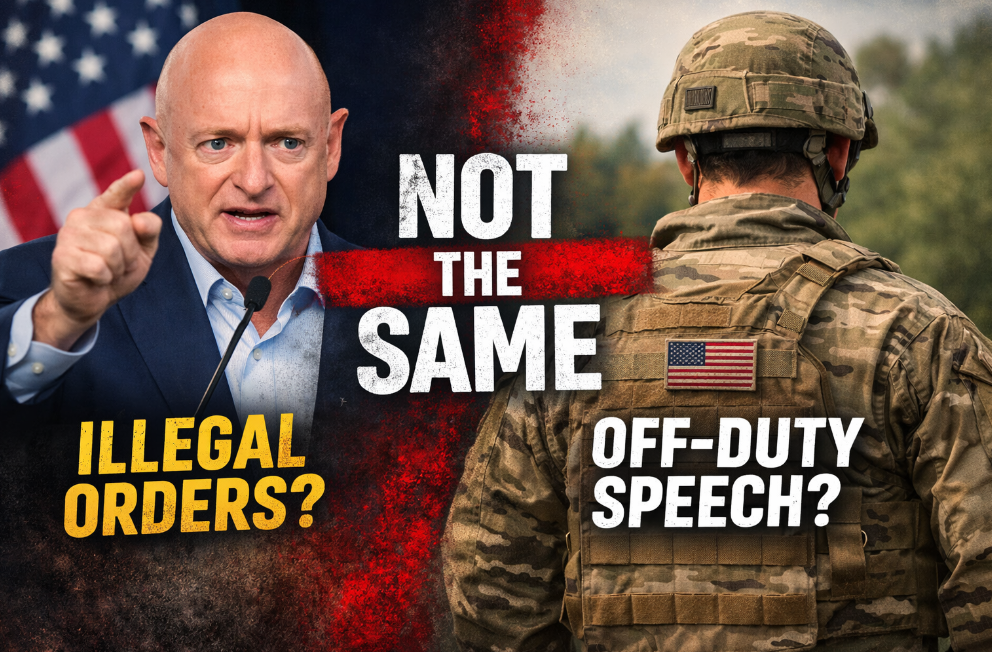
When the Pentagon censured Senator Mark Kelly for telling American troops they have a “duty to disobey illegal orders,” much of the media rushed to frame the controversy as a free-speech issue. Kelly himself soon followed with a federal lawsuit, alleging retaliation by Defense Secretary Pete Hegseth and warning of chilling consequences for dissenting voices.
At first glance, the story seems familiar: a government official punished for speech critical of power. But this framing collapses under even modest scrutiny. Not all speech exists in the same legal universe, and not all speakers carry the same responsibilities. In the military context especially, who is speaking, to whom, and in what capacity matters — a lot.
As a National Guard senior non-commissioned officer currently suing my own chain of command over retaliation for off-duty political speech, I have a direct stake in defending the First Amendment. But that is precisely why Kelly’s case deserves sharper criticism, not reflexive solidarity. His speech was censure-worthy. Mine was not. And confusing the two undermines legitimate free-speech claims while excusing genuinely dangerous conduct.

The Speech That Triggered the Censure
In late 2025, Kelly — a retired Navy captain — joined several former officers-turned-politicians in a video message aimed explicitly at U.S. service members. The message urged troops to remember their oath to the Constitution and asserted that they have a duty to refuse illegal orders.
In abstract civilian discourse, this sounds uncontroversial. Every American has heard “just following orders” condemned since Nuremberg. But the military is not a philosophy seminar. It is a command-based institution charged with the lawful application of force. Within that system, advising disobedience — even conditionally — is not neutral speech.
The Pentagon’s response reflected that reality. Kelly received a formal letter of censure, and the Department of Defense initiated administrative action that could result in loss of retirement rank and benefits. Kelly then sued, arguing that his speech was protected and that the response amounted to political retaliation.
But the core question is not whether civilians may criticize the government. It is whether a retired officer, leveraging his rank and authority, may publicly instruct active troops on when to disobey orders without consequence.
Why This Was a Military Problem — Not a Civil Liberties One
1. Military Speech Is a Separate Legal Category
The First Amendment does not operate identically inside the armed forces. Courts have consistently recognized that military necessity justifies restrictions on speech that would be impermissible in civilian life. Good order, discipline, and unity of command are not abstractions; they are prerequisites for survival.
Kelly is not merely a senator speaking as a private citizen. He is a retired officer who remains subject to recall and whose retirement status is governed by statute. The law explicitly allows the Department of Defense to discipline retired officers whose conduct brings discredit upon the service or undermines command authority.
That authority exists for a reason. Retired officers retain influence, credibility, and moral weight among active troops. When they speak to service members, they do so with institutional gravity whether they acknowledge it or not.
2. Audience Matters More Than Intent
Kelly’s defenders often insist that he was merely restating black-letter law. But military discipline is not governed by academic disclaimers. The issue is not whether illegal orders should be disobeyed — everyone agrees they should. The issue is who gets to decide, and when.
Active-duty service members are trained to rely on lawful command structures, judge advocate general (JAG) guidance, and formal refusal procedures — not social-media videos from politicians. Encouraging troops to self-adjudicate legality in real time invites hesitation, confusion, and fragmentation under stress.
That is precisely why military law places extreme caution around messaging that could be interpreted as counseling disobedience, even conditionally. Kelly’s video crossed that line.
3. Rank Is Not a Costume You Can Take Off
Kelly’s lawsuit treats his military identity as something he can toggle on and off — invoking it for credibility while disclaiming it for accountability. That is not how military service works.
If retired rank confers honor, pension, and public trust, it also carries enduring obligations. The Pentagon’s authority over retirees is not novel, and it is not political invention. Kelly knew this when he accepted retirement under those terms.
Why My Speech Is Categorically Different
My own lawsuit — documented in detail elsewhere — involves off-duty political speech, made as a citizen, outside any military context, unrelated to command authority, obedience, or troop conduct.
I did not address service members.
I did not advise disobedience.
I did not invoke rank or authority.
I did not speak on behalf of the military.
Yet my chain of command retaliated anyway — through adverse evaluations, subjective counseling statements, and career damage — precisely because my views were unpopular.
That is the classic First Amendment violation Kelly claims to fear but did not experience.
The difference is not subtle:
| Kelly | My Case |
|---|---|
| Speech directed at troops | Speech directed at civilians |
| Leveraged retired officer authority | Spoke purely as a citizen |
| Addressed obedience to orders | Addressed public policy |
| Subject to UCMJ-adjacent authority | Not subject for the speech |
| Discipline grounded in statute | Retaliation lacking legal basis |
Conflating these cases does not strengthen free-speech protections. It weakens them by erasing the boundary between legitimate military discipline and unlawful retaliation.
The Dangerous Precedent Kelly’s Defense Encourages
Ironically, Kelly’s argument — if accepted wholesale — would make my case harder to win.
If any speech by anyone with a military background can be recharacterized as protected political expression regardless of audience or effect, then commanders will be incentivized to clamp down more aggressively on actual civilian speech to avoid being accused of selective enforcement.
Clear boundaries protect liberty. Blurred ones empower bureaucracies.
The military must be restrained from punishing lawful off-duty speech. But it must also retain authority to prevent influential figures from encouraging operational ambiguity and selective obedience.
Conclusion: Free Speech Requires Precision, Not Slogans
The First Amendment is not defended by flattening every controversy into a single narrative of “speech versus power.” It is defended by understanding context, authority, and law.
Senator Mark Kelly was not censured for holding the wrong opinion. He was censured for using his status as a retired officer to issue guidance — however well-intended — that intruded into the chain of command and the lawful administration of force.
My speech, by contrast, was political expression as a private citizen — precisely the category the First Amendment exists to protect.
If insurgency means anything, it must begin with intellectual honesty. And honesty requires saying what many commentators refuse to say: these cases are not the same — and pretending otherwise serves neither liberty nor the Constitution.