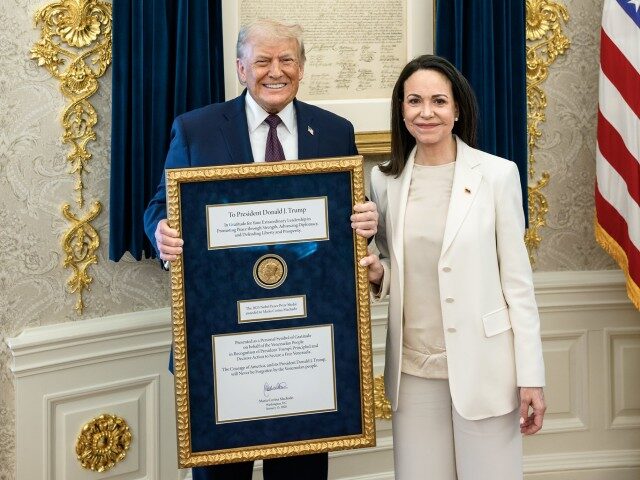
Venezuelan opposition figure María Corina Machado visited the White House on Thursday and presented President Donald Trump with her 2025 Nobel Peace Prize medal in a highly symbolic diplomatic gesture. Machado’s visit and the medal presentation underscore the ongoing geopolitical struggle for Venezuela’s future, as well as Trump’s role in regional affairs.
Machado, who leads Venezuela’s center-right Vente Venezuela party and has spent years championing democratic reform in her crisis-wracked nation, was awarded the Nobel Peace Prize in October for her efforts promoting democratic rights and a peaceful transition from dictatorship. She dedicated the award to the Venezuelan people and publicly acknowledged President Trump’s actions in supporting freedom efforts, including a U.S. operation to remove authoritarian leader Nicolás Maduro from power earlier this month.
In a private meeting at the White House, Machado handed over the gold Nobel Peace Prize medal to Trump as a personal token of appreciation. The president confirmed on social media that the Nobel medal was presented to him and called the meeting a “wonderful gesture of mutual respect.” A White House official also confirmed that Trump accepted the medal.

From a traditional and biblical viewpoint, this moment highlights the complex interplay of international leadership, moral authority, and the fight for democratic freedom. Venezuela under Maduro descended into tyranny marked by repression, economic collapse, and a suffering population that has cried out for liberty and human dignity. Machado’s recognition by the Nobel Committee was explicitly for her lifelong struggle to uplift the Venezuelan people from that oppressive reality—work that aligns with timeless principles of justice and freedom.
However, the act of giving the medal to Trump has stirred controversy beyond political circles. The Norwegian Nobel Institute clarified that Nobel Peace Prizes technically cannot be transferred or shared once awarded, though the physical medal itself may change hands as a keepsake. This clarification means that while Trump may physically hold the medal, he is not officially recognized as a Nobel laureate.
Critics both inside and outside Norway have weighed in. Some European politicians have dismissed the gesture as “absurd” or as politicizing what is meant to be a neutral global honor. Others argue the action reflects Machado’s strategic positioning to secure broader support for her cause and to emphasize Trump’s influence on Venezuela’s unfolding political dynamics.
The meeting also reflects Trump’s growing footprint in Latin America: navigating the ongoing Venezuelan political uncertainty, weighing diplomatic alliances, and balancing relations with interim leaders in Caracas, including Vice President Delcy Rodríguez, who has assumed authority following Maduro’s removal. Rodriguez’s government has shown interest in reform, particularly in opening Venezuela’s oil industry to investment—a key concern for global energy markets and U.S. economic interests.
For supporters of freedom and traditional values, Machado’s gesture is more than mere symbolism. It represents an acknowledgment of the struggle against tyranny and the belief that strong leadership, rooted in respect for human dignity and liberty, can make a lasting difference. In a world where the moral order and rule of law are frequently contested, such moments carry significant weight.
As international debates continue over Venezuela’s path forward, the Nobel medal now resting with President Trump — even as a ceremonial token — keeps the spotlight on the enduring quest for liberty, the responsibilities of leadership, and the complex web of modern geopolitics.