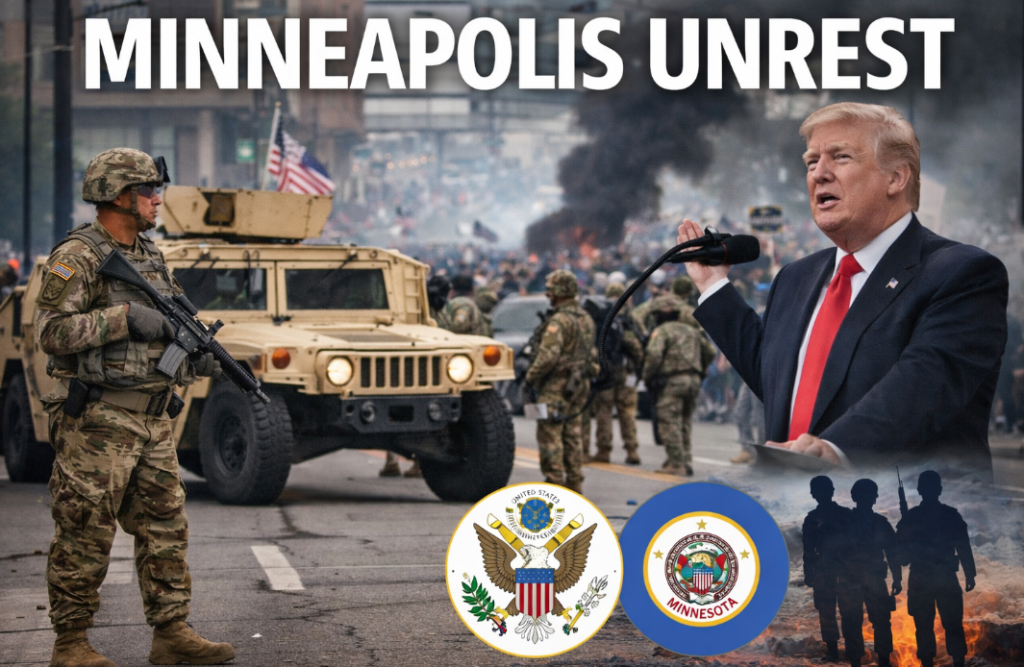
In the midst of ongoing unrest in Minneapolis tied to federal immigration enforcement, National Guard troops have been mobilized within the city as tensions between protesters and law enforcement continue to rise.
Video and eyewitness reports show Humvees and National Guard troops moving through Minneapolis streets, responding to a volatile situation sparked by recent federal actions in the city.
President Donald Trump, confronting persistent clashes tied to Operation Metro Surge — the largest federal immigration enforcement operation in the Twin Cities in recent memory — has publicly threatened to invoke the Insurrection Act if local officials fail to maintain order.

At a press briefing, Trump stated the Insurrection Act is a “very powerful” tool available to the presidency, though he also said there was not yet a need to invoke it. The Insurrection Act, a seldom-used statute dating back to 1807, allows the president to deploy federal troops within U.S. borders to quell unrest. Critics argue its use risks overreach of executive power, but the administration frames it as necessary to restore lawlessness and protect federal agents.
Maj. General Shawn Manke, Adjutant General of the Minnesota National Guard, confirmed elements of the Guard have been mobilized to support local law enforcement, emphasizing that their role is to assist in stabilizing public order.
The unrest originated after the fatal shooting of Renée Good, a 37-year-old Minneapolis woman, during an encounter with a U.S. Immigration and Customs Enforcement (ICE) agent, an incident that has deeply polarized public opinion and fueled protests. Peaceful demonstrations have frequently escalated to clashes with law enforcement, prompting officials to prepare broader security responses.
Minnesota Governor Tim Walz previously issued a warning order to prepare the National Guard in response to the escalating protests, a move state leaders describe as proactive while reaffirming control remains with local authorities. The Guard’s mobilization reflects increasing concerns about public safety as dueling rallies and demonstrations draw large crowds in downtown Minneapolis.
Critics of the federal presence in Minneapolis warn that the heavy use of National Guard troops and federal agents in civilian cities risks undermining constitutional norms and civil liberties. Supporters, conversely, argue that without such measures, lawlessness and threats to public safety, including violent clashes and attacks on law enforcement, could intensify.
The situation remains fluid, with both federal and local authorities grappling with how best to maintain order amid deep political and cultural divisions over immigration policy, public safety, and the proper scope of government authority.