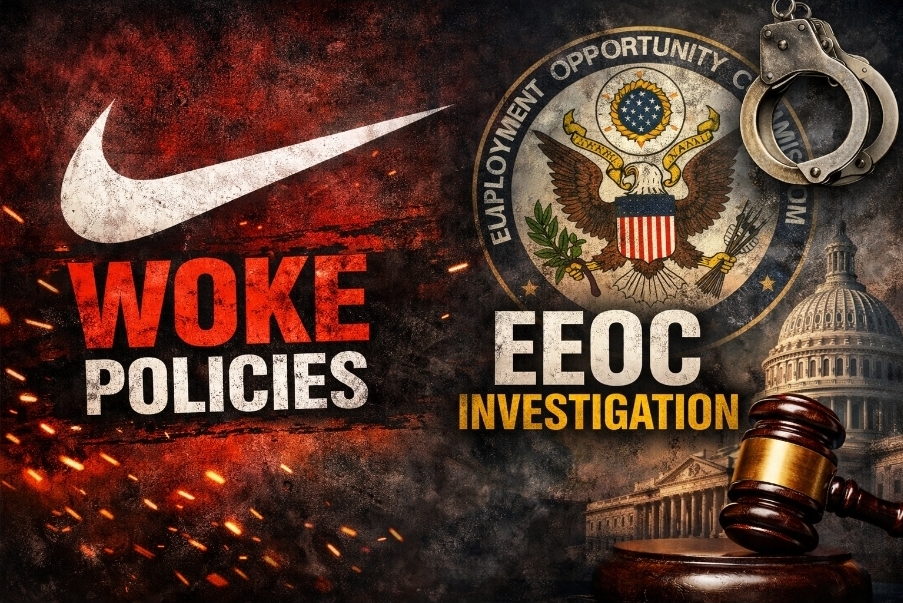
The woke corporate experiment at Nike has run headlong into a legal showdown with the federal government, as the U.S. Equal Employment Opportunity Commission (EEOC) — under the leadership of President Donald Trump’s administration — has formally escalated its probe into alleged race-based discrimination at the company.
According to reporting by Bryan Chai at the Western Journal, on February 4, 2026, the EEOC filed a subpoena enforcement action in federal court to compel Nike to produce extensive internal documents tied to its Diversity, Equity, and Inclusion (DEI) programs. The action stems from allegations that these programs resulted in systemic discrimination against white employees, applicants, and participants in training and career development opportunities.
Critically, the agency alleges that Nike may have engaged in a “pattern or practice of disparate treatment” in key employment decisions — including hiring, promotions, layoffs, mentorship, internships, and leadership development — that disadvantaged white workers. The EEOC’s request for information reaches as far back as 2018, seeking data on how the company used race and ethnicity information in decisions affecting its workforce.

Nike initially provided thousands of pages of documents in response to earlier inquiries, but according to the EEOC, that was not sufficient — prompting the agency to take the rare step of forcing compliance through the courts. EEOC Chair Andrea Lucas — appointed by President Trump — stated that when there are indications a company’s policies may violate federal anti-discrimination laws, the EEOC will pursue “all necessary steps” to investigate fully.
Under Title VII of the Civil Rights Act of 1964, race-based employment discrimination is unlawful regardless of the target race. The Trump administration has emphasized that civil rights protections apply to all Americans, and the Nike investigation reflects that renewed focus.
This legal action aligns with broader policy shifts within the administration. President Trump has issued executive orders curtailing federal support for DEI initiatives and urging closer scrutiny of corporate diversity programs. His appointees in multiple agencies have interpreted these measures as a call to enforce the original civil-rights principle that opportunity must be color-blind and rooted in merit, not group identity.
For many Americans, the Nike case symbolizes more than a legal dispute — it represents a wider debate over the role of race in corporate America. Critics of DEI programs contend that policies framed around group identities can inadvertently promote division and sideline individuals based on immutable traits rather than character and ability. From a biblical and traditional worldview, this is deeply problematic, as Scripture calls believers to judge others by the content of their character, not their skin color (cf. Romans 2:11).
Nike, for its part, insists it complies with all applicable laws and has cooperated with the EEOC. However, the company now faces increased scrutiny over whether its DEI initiatives crossed the line into unlawful conduct — a concern that could have far-reaching implications for corporate diversity policies nationwide.
As the legal proceedings unfold, both businesses and policymakers will be watching closely to see how the principles of equity, fairness, and equal protection under the law are balanced in America’s workplaces.