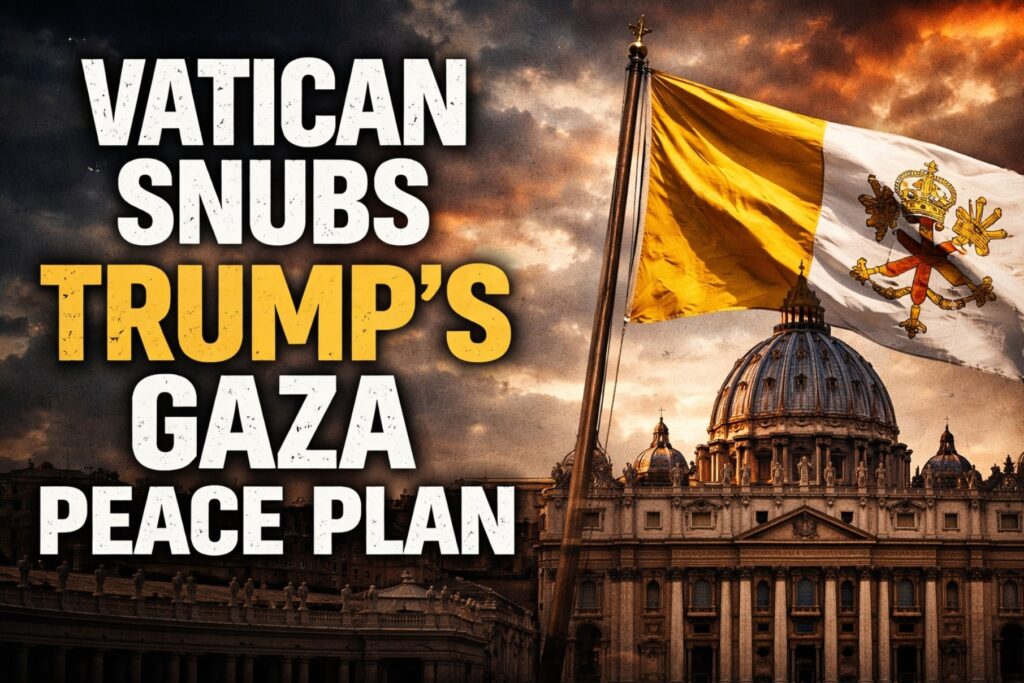
The Vatican has declined an invitation to participate in former President Donald Trump’s proposed Gaza peace board, signaling the Holy See’s preference to maintain its traditional diplomatic posture rather than take part in a politically structured initiative.
According to a report from Fox News, representatives of the Holy See confirmed that while the Vatican remains committed to praying for peace and encouraging dialogue in the Middle East, it would not accept a formal seat on a board organized under Trump’s framework for addressing the ongoing conflict in Gaza. The decision underscores the Vatican’s longstanding approach of operating through quiet diplomacy rather than direct political alignment.
Trump’s proposed board was reportedly designed to bring together international religious and political leaders to help shape a long-term resolution to the war in Gaza, which has intensified following Hamas’ October 7 terrorist attacks against Israel and the subsequent Israeli military response. The violence has left thousands dead and displaced many more, placing renewed global attention on efforts to broker peace in the region.

While the Vatican declined to join the formal structure, it reiterated its desire for an immediate ceasefire and humanitarian relief for civilians affected by the fighting. Pope Francis has repeatedly called for peace in the Holy Land, urging both sides to lay down arms and prioritize human dignity.The Holy See has historically maintained diplomatic relations with both Israel and Palestinian authorities, carefully balancing its messaging in one of the world’s most volatile regions. Vatican officials indicated that joining a political board—particularly one associated with a specific U.S. political figure—could compromise its perceived neutrality and long-standing diplomatic channels.
Trump, who has positioned himself as a dealmaker in international affairs, previously brokered the Abraham Accords during his presidency, normalizing relations between Israel and several Arab nations. His renewed interest in facilitating a Gaza solution appears to be part of a broader effort to reassert American leadership in Middle Eastern diplomacy.
The Vatican’s decision highlights a broader tension between political initiatives and ecclesiastical diplomacy. While civil authorities bear responsibility for wielding the sword to restrain evil and secure peace, the Church’s primary mission remains spiritual—calling nations to repentance, justice, and reconciliation before God. Scripture reminds believers that true peace is not merely the absence of conflict but the fruit of righteousness.
Even so, geopolitical realities require governments to act decisively in the face of terrorism and instability. Hamas’ actions have drawn international condemnation, and Israel’s right to defend its citizens has been widely affirmed among Western allies. Efforts to achieve lasting peace must reckon honestly with the roots of violence, the necessity of security, and the moral accountability of leaders on all sides.
The Vatican’s refusal to join Trump’s proposed board does not close the door to its involvement in peacemaking but reinforces its preference for prayerful diplomacy over formal political entanglements. As the conflict continues, the world watches to see whether renewed initiatives—whether political, diplomatic, or spiritual—can bring stability to a region long scarred by war.