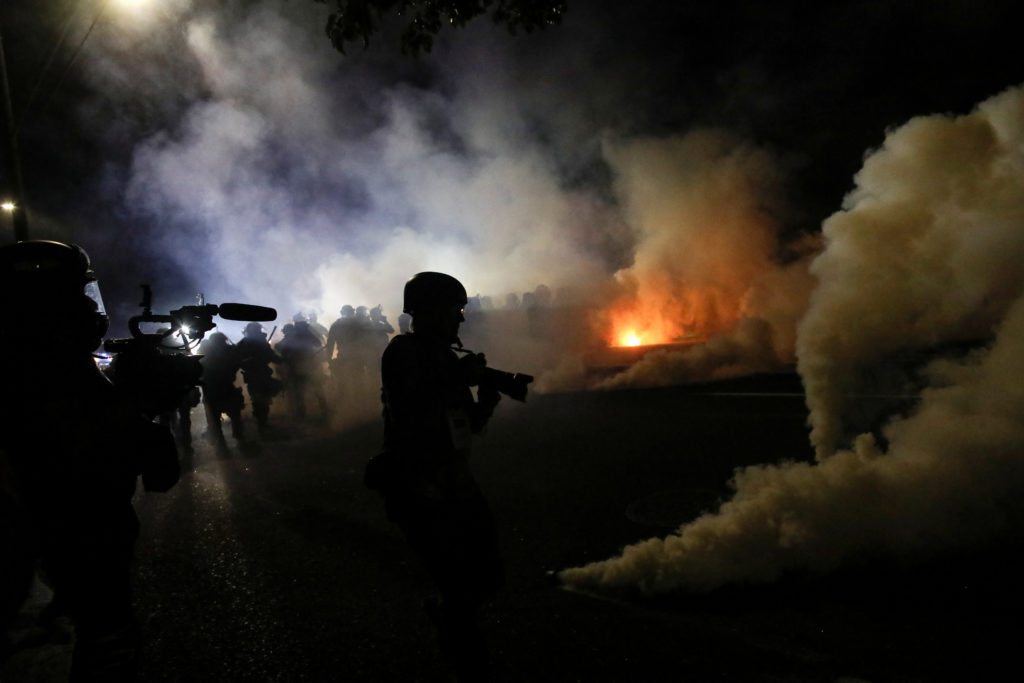
Minnesota became the focal point of renewed national tension over immigration enforcement in late January after a fatal shooting during an ICE operation in Minneapolis triggered violent protests, property damage, and political fallout—prompting President Donald Trump to signal that federal authorities may ultimately withdraw from the state.
The unrest began with the fatal shooting of 37-year-old Alex Pretti during an attempted detention by U.S. Immigration and Customs Enforcement agents. Federal officials stated that Pretti approached officers while armed with a 9mm semi-automatic handgun and additional magazines, resisted commands, and was disarmed during a physical struggle before being shot. Authorities have said video footage supports their account, though the incident remains the subject of public dispute and investigation.
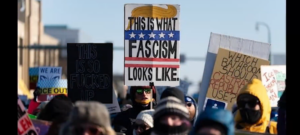
Pretti was described by federal officials as an agitator interfering with an enforcement action, while other outlets identified him as an ICU nurse—an inconsistency that has fueled public outrage and activist mobilization. Within hours, demonstrations erupted across Minneapolis, with activists framing the shooting as evidence of federal overreach.

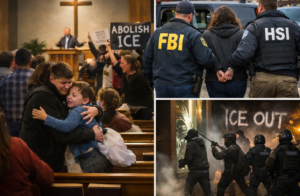
That anger quickly escalated into violence later that night when a group of masked protesters descended on a Home Suites by Hilton near the University of Minnesota campus, believing ICE agents were staying there. The crowd banged on garbage bins, chanted slogans, smashed windows, spray-painted messages such as “ICE OUT OF MPLS,” and attempted to force their way inside the hotel.
According to reports, the disturbance continued for more than an hour with little initial police response. Federal agents eventually arrived and dispersed the mob using flares and tear gas, arresting at least two individuals. One federal agent was reportedly injured after being struck in the face with a brick. It remains unconfirmed whether ICE personnel were actually lodging at the hotel.
President Trump addressed the situation publicly, expressing regret over the loss of life while also condemning the presence of firearms amid volatile protests. “I don’t like any shooting. I don’t like it,” Trump said. “But I don’t like it when somebody goes into a protest and he’s got a very powerful, fully-loaded gun with two magazines loaded up with bullets also. That doesn’t play good either.”
When asked about ICE’s continued presence in Minnesota, the president signaled a possible pullback, citing the dangerous environment facing federal agents. “We’re looking, we’re reviewing everything and will come out with a determination,” Trump said, adding, “At some point we will leave,” even as he praised ICE personnel for doing “a phenomenal job.”
Conservative commentators have argued that Minnesota’s status as a sanctuary state—combined with open resistance from Democratic officials—has made lawful immigration enforcement increasingly untenable. The state has been the subject of prior reporting alleging coordinated efforts by activist networks to track, harass, and dox ICE agents, sometimes using encrypted messaging platforms tied to political operatives.
Minnesota Governor Tim Walz sharply criticized the federal operation, framing the shooting as an abuse of power. “What side do you want to be on?” Walz asked. “The side of an all-powerful federal government that can kill, injure, menace and kidnap its citizens off the streets or on the side of a nurse at the VA who died bearing witness to such government.”
To critics, such rhetoric only emboldens disorder and places federal officers at greater risk. They argue that the violent backlash in Minneapolis is not spontaneous but the predictable result of years of radical policies that elevate ideological opposition to immigration enforcement over public safety and the rule of law.
From a biblical perspective, Scripture teaches that civil authorities are instituted by God to restrain evil and preserve order (Romans 13). When political leaders encourage defiance of lawful authority—or excuse mob violence—they erode the foundations of justice and invite chaos. Whether ICE ultimately withdraws from Minnesota or presses forward, the events of late January underscore a sobering reality: a nation divided over the meaning of law, authority, and accountability cannot remain at peace indefinitely.