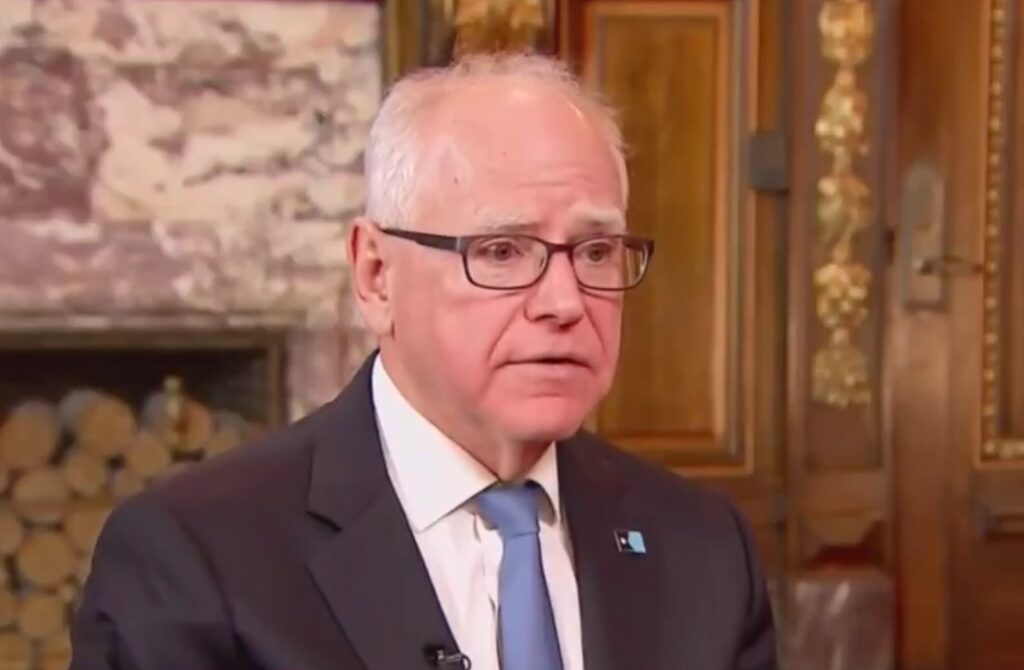
Minnesota Governor Tim Walz has announced that he will never again seek elected office, closing the door on a political career increasingly defined by scandal, national embarrassment, and broken public trust, as reported by The Daily Wire.
In an interview this week, Walz stated bluntly, “I will never run for an elected office again. Never again,” offering no apology or reflection on the controversies that have engulfed his administration and damaged his credibility with voters. The declaration follows months of political turmoil, capped by his failed run as the Democratic Party’s vice-presidential nominee in the 2024 election.
Walz’s national ambitions collapsed last November when the Harris–Walz ticket was soundly defeated, ending Democrats’ hopes of extending their hold on the White House. The campaign exposed Walz to national scrutiny, reviving unresolved questions about his past and highlighting policy failures that had previously been contained within Minnesota politics. Rather than elevating his profile, the VP bid amplified concerns about his judgment and honesty.

Among the most damaging issues resurfacing during the campaign was Walz’s long-standing stolen valor scandal. Walz has repeatedly portrayed his military service in ways that critics say exaggerated his rank and experience, particularly regarding claims connected to service in Iraq. While Walz served honorably in the National Guard, documented records contradicted several of his public statements, leading veterans and watchdog groups to accuse him of misleading the public for political gain. Walz has never fully addressed these discrepancies, instead dismissing criticism as partisan attacks.
Back home, Walz’s governorship has been overshadowed by a massive fraud scandal involving Minnesota’s social service programs. Billions of taxpayer dollars intended to feed low-income children were siphoned off through nonprofit networks under his administration’s watch, raising serious questions about accountability and stewardship. For many Minnesotans, the scandal symbolized a broader pattern of progressive governance that expands bureaucracy while abandoning moral responsibility.
Walz has also faced backlash over his response to law enforcement and public safety crises, including resistance to federal immigration enforcement and public statements perceived as undermining police authority. Critics argue that these positions contributed to disorder and weakened respect for lawful authority—principles Scripture teaches are essential to a just society.
Despite these failures, Walz framed his departure as a personal choice rather than a reckoning. He suggested he would continue serving “in other ways,” without specifying how. Notably absent from his remarks was any acknowledgment of wrongdoing or repentance—an omission that has frustrated voters seeking humility and accountability from public servants.
Walz’s exit opens the door to a contentious race for Minnesota’s future, as Democrats scramble to distance themselves from his legacy and Republicans argue for a return to fiscal discipline, public safety, and moral clarity. For many observers, Walz’s decision to step aside is less a noble retirement than an admission that his political credibility has been exhausted.
As Minnesota prepares for its next chapter, Walz’s career stands as a cautionary tale: ambition without integrity, power without accountability, and leadership untethered from truth ultimately lead to collapse.