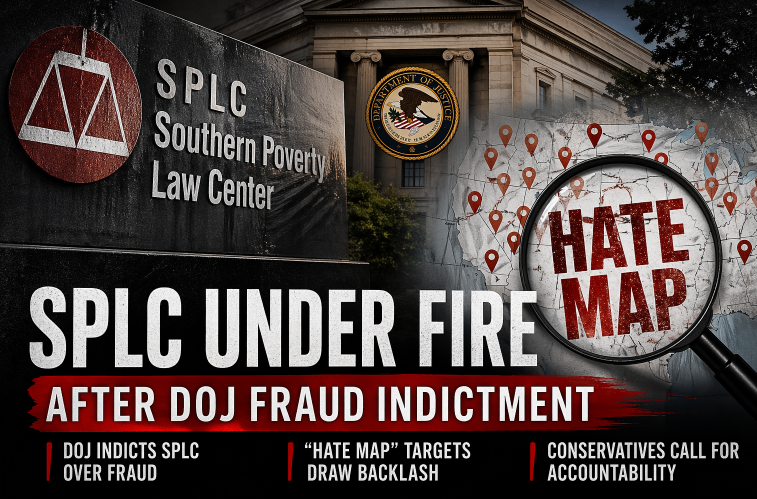
As reported by Fox News, the Southern Poverty Law Center (SPLC) is facing renewed backlash from organizations it has labeled on its widely circulated “hate map,” following a Department of Justice fraud indictment involving a former SPLC attorney.
The indictment, announced by federal prosecutors, charges the former SPLC employee with wire fraud and money laundering tied to an alleged scheme involving falsified billing and misuse of funds. While the charges are directed at an individual rather than the organization as a whole, critics argue the case raises broader concerns about the integrity and accountability of the SPLC’s operations.
For years, the SPLC has published its annual “hate map,” identifying groups it classifies as “extremist” or “hate-based.” Many conservative and Christian organizations have strongly rejected those labels, arguing they are rooted not in violence or unlawful conduct, but in adherence to biblical convictions on issues such as marriage, sexuality, and the sanctity of life. These groups maintain that being placed on the list has led to reputational harm, financial consequences, and even security threats.

In the wake of the DOJ indictment, several of these organizations are renewing calls for scrutiny of the SPLC’s influence. They argue that an institution claiming moral authority to label others should itself be held to a high standard of transparency and ethical conduct. Some have also pointed to past incidents in which individuals cited the SPLC’s “hate map” as justification for targeting conservative organizations, raising concerns about the real-world impact of such classifications.
The controversy highlights a deeper cultural divide over the definition of “hate” in modern America. From a biblical perspective, many Christian leaders emphasize that standing for truth—particularly regarding God’s design for male and female, marriage, and human life—should not be equated with hatred. Rather, they argue that moral clarity and conviction are essential to a just and ordered society.
At the same time, the situation raises important questions about the concentration of influence in unelected advocacy groups. When organizations wield significant power to shape public perception, critics contend that accountability becomes not only appropriate but necessary. The DOJ case, though limited in scope, has become a flashpoint for broader concerns about institutional bias and the weaponization of labels against ideological opponents.
The SPLC has not been charged in connection with the alleged fraud, and the legal process against the former employee is ongoing. Nevertheless, the episode has intensified scrutiny of the organization’s practices and renewed debate over its role in American public life.
For many observers, the issue ultimately returns to a foundational principle: truth matters. In a society increasingly divided along ideological lines, the call for honesty, fairness, and accountability resonates deeply—particularly among those who believe that justice must be rooted in objective moral standards rather than shifting cultural narratives.