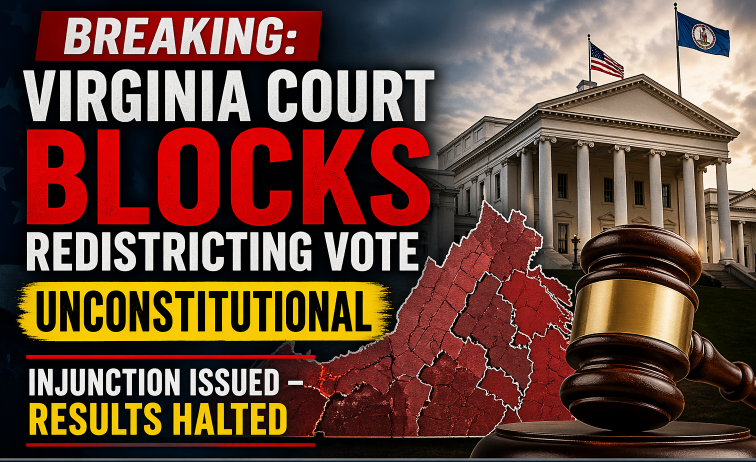
A Virginia Circuit Court has ruled that a recent redistricting vote is unconstitutional, issuing an injunction that blocks the results from being certified and setting the stage for a potentially decisive legal battle in the state’s highest court.
The development, first highlighted by former Virginia Attorney General Ken Cuccinelli on X, represents a significant turn in an already contentious process. Cuccinelli reported that the ruling effectively halts the implementation of the redistricting outcome, preventing it from taking legal effect while the matter is further contested.
According to the report, the court’s decision centers on constitutional concerns surrounding how the redistricting vote was conducted. While details of the court’s reasoning are still emerging, the injunction signals that the judge found sufficient legal merit to stop certification immediately—an extraordinary step that underscores the seriousness of the challenge.

Redistricting battles have become a flashpoint across the nation in recent years, often raising questions about fairness, representation, and the proper role of government authority. From a biblical and constitutional perspective, such disputes highlight the importance of just governance and equal weights and measures—principles rooted in Scripture that call leaders to act with integrity and impartiality.
The ruling also reinforces the role of the judiciary as a check on potential overreach. When processes that shape representation are called into question, courts are often the final safeguard to ensure that the rule of law—not political expediency—prevails.
This case appears far from settled. Observers widely expect the issue to escalate to the Virginia Supreme Court, which will likely have the final say on whether the redistricting vote can stand. That next phase could carry major implications for how legislative districts are drawn and how political power is distributed across the state.
For citizens concerned about election integrity and fair representation, the case serves as a reminder that vigilance remains necessary. Legal challenges like this one demonstrate that the mechanisms of accountability are still active, even amid intense political pressure.
As the situation develops, Virginians—and Americans watching from afar—will be looking to see whether the state’s highest court upholds the injunction or allows the redistricting process to move forward. Either outcome will shape not only the political landscape but also public confidence in the systems that govern representation.
For now, the court’s message is clear: the process is not yet settled, and the fight over redistricting in Virginia is far from over.