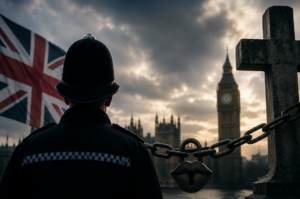
In case you missed it, a former British police officer has reached a legal settlement after being suspended, investigated, and effectively pushed out of his job for asking questions during workplace diversity training—an episode that many critics say exposes a growing hostility toward free expression in the United Kingdom.
As reported by BBC News, former North Yorkshire Police Community Support Officer Luke Salmons alleged he faced discrimination because of his Christian beliefs after raising questions about Islam and the conflict in Gaza during training sessions.
According to Salmons, one training course devoted significant attention to Islam and included repeated assertions that “Islam is a religion of peace.” He later described the atmosphere as one of ideological instruction rather than balanced education. North Yorkshire Police disputed that characterization and denied any religious indoctrination occurred.

What happened next is what has drawn the greatest concern from free speech advocates.
Salmons said he participated in what he believed was an open discussion during a training session led by a Muslim police sergeant. He described the exchange as respectful and believed attendees had been encouraged to ask difficult questions. Yet just two days later, he was suspended.
A professional standards panel eventually determined that his conduct amounted to gross misconduct and placed him on a policing barred list, effectively ending his law enforcement career. However, after an appeal, Chief Constable Tim Forber overturned that finding, concluding that while there were concerns about Salmons’ behavior, it did not constitute gross misconduct and did not violate professional standards. His name was subsequently removed from the barred list.
That reversal raises an obvious question: If Salmons’ actions did not violate police standards, why was he suspended, investigated, and subjected to career-ending sanctions in the first place?
Supported by Christian Concern and the Christian Legal Centre, Salmons later brought claims alleging unlawful discrimination and violations of his rights to freedom of religion and freedom of expression. The case has now been settled on confidential terms.
The broader significance extends well beyond one officer.
Across Britain, concerns have mounted in recent years over the narrowing boundaries of acceptable speech, particularly regarding religion, immigration, identity politics, and cultural issues. Critics argue that institutions increasingly encourage “open dialogue” in theory while punishing those who express views that challenge prevailing orthodoxies in practice.
For many observers, the Salmons case serves as another example of a troubling double standard. Diversity and inclusion programs frequently promote discussion and understanding, yet participants who ask difficult questions about sensitive topics can find themselves facing professional consequences.
North Yorkshire Police maintains that it respects the rights of individuals to hold different beliefs and remains committed to creating an inclusive workplace. But the fact remains that an officer was suspended, accused of gross misconduct, and effectively driven from his position before senior leadership ultimately determined his conduct did not warrant such punishment.
Whether one agrees with Salmons’ views or not, the case highlights a growing concern throughout the Western world: the erosion of a culture where citizens can ask challenging questions without fear that their livelihoods will be placed at risk. Free societies depend not on enforced consensus, but on the ability to engage in respectful disagreement—even on the most sensitive subjects.