
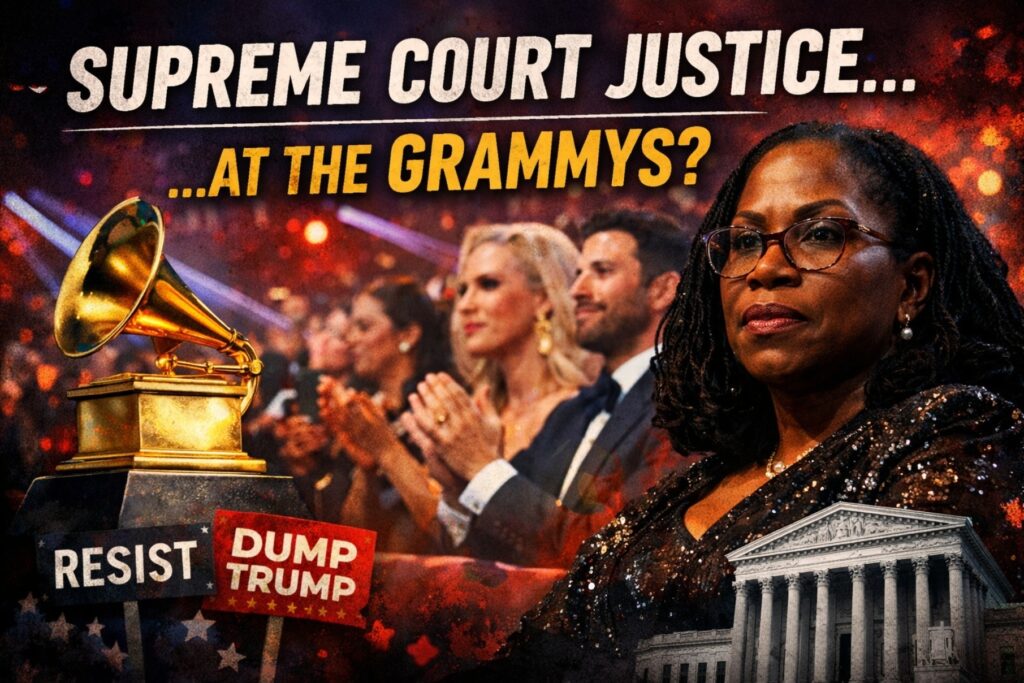
Supreme Court Justice Ketanji Brown Jackson drew widespread attention at the 68th Annual Grammy Awards when she was seen seated in the audience at the star-studded music industry gala. Her presence among celebrities and entertainers competing for music’s highest honors raised questions about the appropriate role of a sitting justice in what many conservative observers view as a politically charged cultural event.
The Grammy Awards ceremony in Los Angeles is known for its glitzy performances, liberal hosting choices, and a history of promoting progressive causes on stage and camera. This year’s broadcast included politically infused moments, including protest-style messages and celebrity critiques of immigration policy — remarks that align with the entertainment industry’s cultural agenda.
Justice Brown Jackson was not just a photo opportunity — she was in attendance because she was nominated for a Grammy herself. The Justice earned a nomination in the Best Audio Book, Narration & Storytelling Recording category for her spoken-word audiobook, placing her alongside high-profile figures including host Trevor Noah and other entertainers.

While it is not unprecedented for public figures outside the music world to receive Grammy nominations — authors, actors, and public personalities are sometimes recognized for audiobook work — the optics of a Supreme Court justice attending an awards show closely tied to liberal pop culture advocacy struck many commentators as unusual. Conservative critics argued that such visibility in an entertainment setting known for political messaging could undermine perceptions of judicial impartiality and blur traditional boundaries between the judiciary and cultural elites.
Not the Bee’s coverage framed Justice Brown Jackson’s attendance with sharp skepticism, noting the show’s pronounced political undertones and suggesting that her presence in that environment raised legitimate concerns: “It’s one thing for the woke morons to nominate the non-biologist for a Grammy … It’s an entirely different thing for [her] to actually show up to the Trump-bashing, anti-ICE show.”
Faith-based and conservative outlets have similarly questioned whether justices — whose duty is to uphold the Constitution and maintain the rule of law — should participate visibly in entertainment events that frequently serve as platforms for ideological expression. These critics point to the importance of judges maintaining not only legal impartiality but also the appearance of neutrality in the public square. Others, however, see no inherent conflict in a justice being acknowledged for an artistic or literary accomplishment.
The broader cultural debate reflects ongoing tensions between traditional institutions and contemporary entertainment culture. As the Supreme Court continues to navigate highly contentious legal issues, appearances such as Brown Jackson’s at high-profile, politically expressive events may intensify scrutiny over how justices engage with public life beyond the courtroom.
Ultimately, whether one views her Grammy attendance as a harmless personal achievement or a departure from expected judicial reserve depends largely on one’s perspective about the intersection of law, culture, and politics in America today.