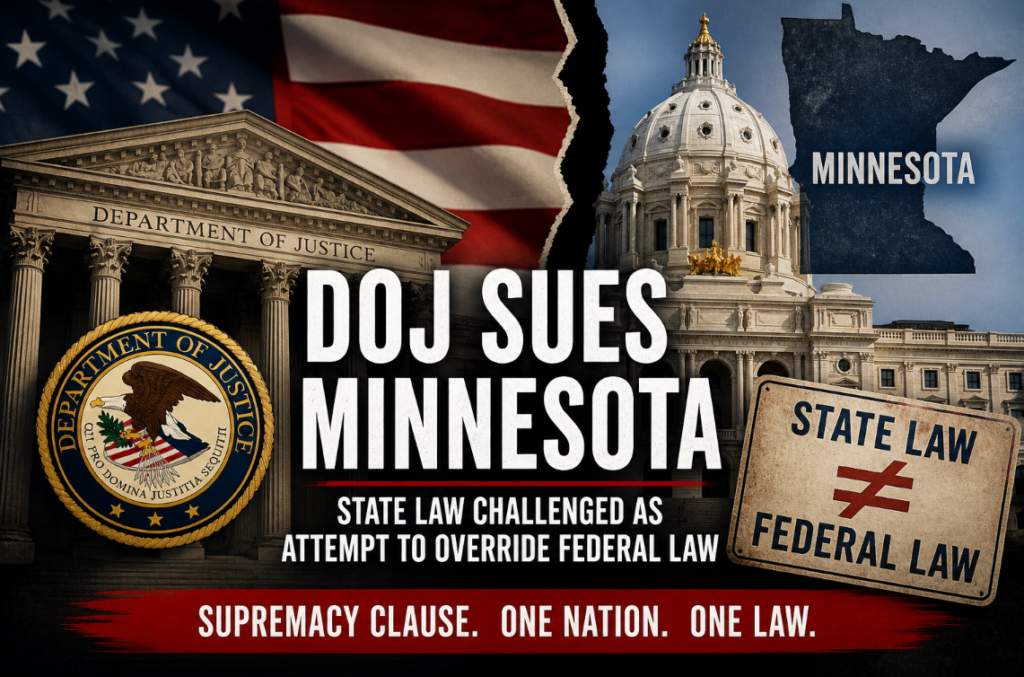
The U.S. Department of Justice has filed a lawsuit against the state of Minnesota, accusing it of attempting to override federal immigration law and obstruct lawful enforcement efforts. As reported by U.S. Department of Justice, the complaint targets a recently enacted state policy that federal officials argue directly conflicts with the Constitution’s Supremacy Clause.
According to the Justice Department, Minnesota’s law places restrictions on how state officials may cooperate with federal immigration authorities, effectively limiting the ability of federal agencies to carry out their duties. The lawsuit asserts that such measures not only undermine national sovereignty but also create confusion and inconsistency in the enforcement of immigration laws—an area the Constitution reserves for the federal government.
Federal officials contend that immigration enforcement must remain uniform across the nation, warning that individual states cannot selectively decide which federal laws they will honor. The complaint emphasizes that the Constitution clearly establishes federal law as the “supreme Law of the Land,” and any conflicting state statutes must yield.

The case reflects a broader and ongoing tension between federal authority and states that have adopted so-called “sanctuary” policies. Supporters of Minnesota’s approach argue that such measures are intended to protect local communities and ensure that state resources are not used for federal immigration enforcement. However, critics—including federal officials—maintain that these policies weaken the rule of law and create safe havens for individuals who are in the country unlawfully.
From a constitutional perspective, the Justice Department’s position underscores the importance of maintaining a consistent legal framework across all states. A patchwork system, where each state sets its own immigration rules, risks eroding the unity and order necessary for a functioning republic.
Beyond the legal arguments, the dispute also highlights deeper cultural and moral questions about national identity, the rule of law, and the role of government. A biblical worldview affirms the importance of lawful order and the proper exercise of authority. Scripture teaches that governing authorities are instituted to uphold justice and restrain wrongdoing (Romans 13:1–4). When laws are selectively enforced or openly resisted, it raises concerns about accountability and the erosion of societal trust.
The outcome of this case could have significant implications for the relationship between state and federal governments, particularly in areas where ideological differences shape public policy. If the court sides with the Justice Department, it may reaffirm federal supremacy in immigration enforcement and limit the ability of states to adopt policies that conflict with national law.
As the legal battle unfolds, it serves as a reminder of the foundational principles that govern the United States: a commitment to the rule of law, the importance of ordered liberty, and the enduring tension between local autonomy and national unity.