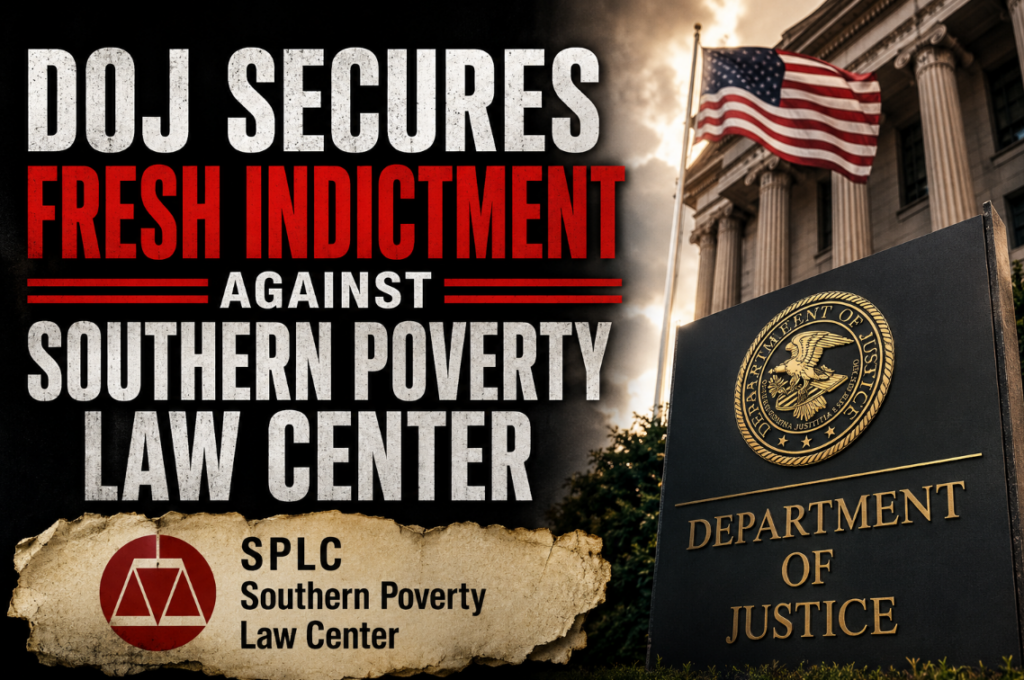
As reported by Bloomberg Law, the U.S. Department of Justice has obtained a superseding indictment against the Southern Poverty Law Center (SPLC), adding new allegations to an already controversial federal fraud case that has drawn national attention.
Federal prosecutors initially charged the Alabama-based organization in April with multiple counts of wire fraud, false statements to a federally insured bank, and conspiracy to commit money laundering. According to the DOJ, the case centers on millions of dollars allegedly paid to confidential informants embedded within extremist organizations while donors were led to believe their contributions were being used solely to combat hate groups and discrimination.
The new indictment reportedly expands on those allegations by providing additional details about how informants were compensated and how funds were allegedly routed through various entities. Prosecutors contend that more than $3 million was directed to individuals connected to organizations such as the Ku Klux Klan and other extremist movements between 2014 and 2023. The government argues that donors and financial institutions were not fully informed about the nature of those payments.

Acting Attorney General Todd Blanche previously accused the SPLC of “manufacturing extremism” by financially supporting individuals involved in hate organizations while publicly presenting itself as an organization dedicated to exposing and opposing those same groups. Federal prosecutors maintain that the case is about fraud and financial misconduct rather than political ideology.
The SPLC has vigorously denied the allegations. Organization leaders argue that the informant program was a legitimate intelligence-gathering effort designed to monitor dangerous extremist activity, prevent violence, and assist law enforcement agencies. They contend the charges represent a politically motivated attack on a long-standing civil rights organization and have pledged to fight the case in court.
The case has sparked significant debate among legal observers. Some attorneys and legal scholars have questioned whether prosecutors can successfully prove the fraud-related charges, while others argue that the allegations, if substantiated, raise serious concerns about donor transparency and nonprofit accountability.
For many conservatives, the indictment raises broader questions about institutions that wield significant influence in shaping public perceptions of extremism and political dissent. Scripture teaches that “whoever walks in integrity walks securely” (Proverbs 10:9), a principle that applies equally to government agencies, nonprofit organizations, and every institution entrusted with the public’s confidence.
The superseding indictment ensures that the legal battle will continue for months ahead as federal prosecutors seek to prove their allegations and the SPLC works to clear its name. The outcome could have far-reaching implications for nonprofit organizations, donor disclosure practices, and the relationship between advocacy groups and the federal government.