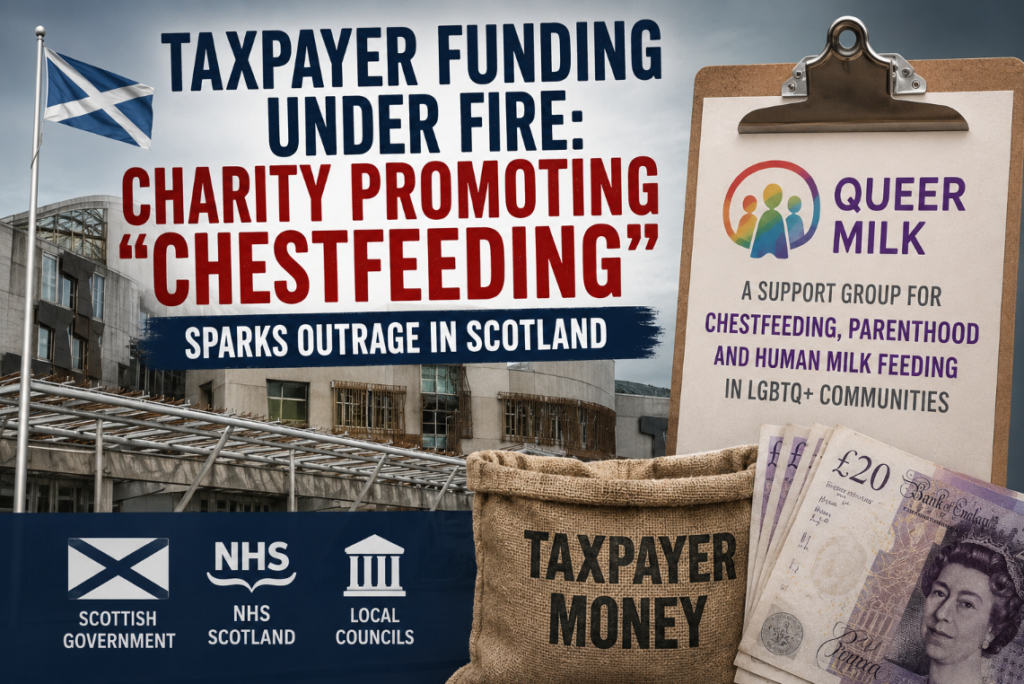
A Scottish charity that receives substantial public funding is facing renewed criticism over a support group that promotes “chestfeeding” and provides support for biological men who identify as women and seek to lactate through hormone treatment.
As reported by GB News, LGBT Health and Wellbeing operates a weekly “Queer Milk” group in Edinburgh in partnership with the Queer Milk Collective. According to the report, the group welcomes individuals who are “breastfeeding, chestfeeding or giving human milk” regardless of their circumstances, including biological men who identify as women.
The controversy centers not only on the group’s mission but also on its funding. According to financial figures cited in the report, LGBT Health and Wellbeing reported income of approximately £1.15 million during the 2024–25 financial year. Much of that funding came from public sources, including the Scottish Government, NHS Lothian, and local government partnerships.

Critics argue that taxpayers should not be funding initiatives they believe promote contested views of biology and human sexuality. Susan Smith, a director of the campaign organization For Women Scotland, criticized the use of public money for what she described as an ideological agenda and questioned the promotion of hormone-induced lactation for biological males.
Supporters of induced lactation argue that hormone treatments can enable some biological men who identify as women to produce milk and cite limited research suggesting it may be possible in certain cases. However, the available scientific evidence remains limited, and the practice continues to be debated within the medical community. Critics maintain that long-term safety data are insufficient and describe the practice as experimental.
The Scottish Government responded that funding provided through its Equality and Human Rights Fund is designated for specific agreed-upon activities and stated that it does not provide funding specifically for lactation services. NHS Lothian likewise confirmed it funds LGBT Health and Wellbeing to deliver a range of support services for “transgender” adults but did not directly state whether it endorses induced lactation.
The controversy comes amid broader debates across the United Kingdom over sex-based language in healthcare, public funding for advocacy organizations, and the role of government in supporting initiatives connected to gender ideology. Many Christians and social conservatives argue that public policy should reflect the biological reality that God created humanity “male and female” (Genesis 1:27) and that taxpayer resources should prioritize essential healthcare and services rather than promoting contested ideological concepts.