
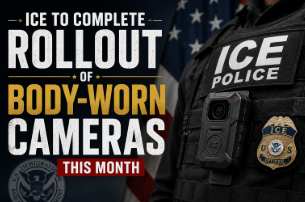
U.S. Immigration and Customs Enforcement is expected to equip all of its officers with body-worn cameras by the end of August, completing a nationwide expansion that agency leadership says is running ahead of schedule.
As reported by The Epoch Times, ICE Acting Director David Venturella announced Aug. 8 that the agency expects to finish deploying the cameras nationwide before the month ends.
“We’re committed to transparency and accountability,” Venturella said.

The expansion marks a significant development for an agency operating on the front lines of the nation’s contentious immigration debate. Body cameras can provide an objective record of encounters involving federal officers, helping protect the public while also giving law enforcement personnel evidence when their conduct is challenged.
ICE’s own policy states that body cameras can promote public trust, improve documentation of encounters, and increase officer and public safety, accountability, and transparency. The agency generally requires cameras to be activated as soon as practicable at the beginning of an enforcement activity.
The program has been developing for years. ICE concluded its body-camera pilot program in March 2023, and during fiscal year 2024 the agency procured more than 6,100 camera systems and licenses while providing body-camera training to hundreds of personnel.
Venturella’s announcement also came amid disagreement over how ICE releases footage to the public. According to The Epoch Times, the acting director disputed an Associated Press report concerning agency policy for releasing body-camera footage following serious incidents.
Venturella argued that ICE’s expedited-release procedures for incidents involving serious injury or death should not be confused with the agency’s broader authority governing release of recordings.
“Those are distinct issues,” he said, adding that footage may not be appropriate for release when disclosure could compromise an investigation or violate privacy protections.
ICE policy says recordings are subject to federal laws and regulations governing records and privacy, including the Freedom of Information Act and Privacy Act.
Border czar Tom Homan has also publicly supported body cameras, arguing that recordings frequently vindicate officers by allowing Americans to see circumstances from the perspective of law enforcement personnel.
The nationwide deployment comes as the Trump administration continues emphasizing immigration enforcement and border security. According to The Epoch Times, federal legislation signed in June provided tens of billions of dollars for immigration enforcement, including personnel, training and equipment such as body cameras.
For conservatives concerned both with restoring the rule of law and holding government accountable, those principles need not be in conflict. A nation has a legitimate responsibility to enforce its immigration laws and secure its borders, while officers entrusted with governmental authority should exercise that authority justly and responsibly.
Body cameras can serve both purposes. When properly used, they create evidence that can expose misconduct where it occurs while protecting officers from accusations contradicted by the recorded facts. In an era when immigration encounters can quickly become political flashpoints, preserving an accurate record may prove increasingly important.
ICE’s planned nationwide deployment therefore represents more than a technological upgrade. It places additional documentation directly alongside federal immigration enforcement, giving the public another means of judging disputed encounters according to evidence rather than political narratives.