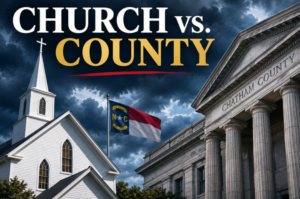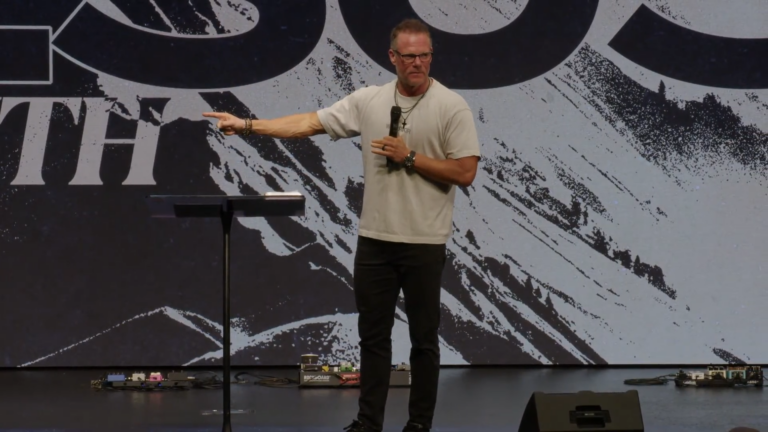
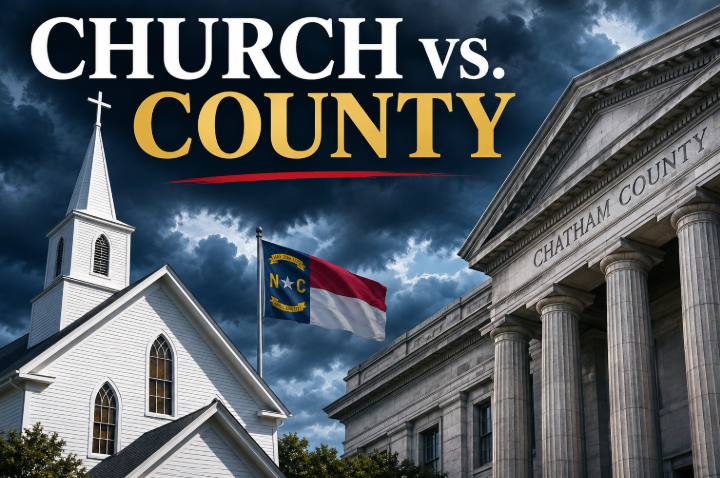
North Carolina officials are defending their decision to block a major expansion by The Summit Church, led by former Southern Baptist Convention President J.D. Greear, arguing that the ongoing federal court battle concerns governmental authority rather than religious discrimination.
As reported by The Christian Post, attorneys for Chatham County appeared before the U.S. Court of Appeals for the Fourth Circuit to challenge a preliminary injunction granted to the church following the county’s rejection of its rezoning application.
The dispute involves nearly 100 acres of property intended for the church’s Chapel Hill campus. Summit Church maintains that the county’s refusal to approve the rezoning unlawfully interferes with its ability to expand its ministry and exercise its religious rights.

The case raises important questions about constitutional protections for religious institutions and the limits of local government authority.
County Argues Federal Courts Cannot Dictate Zoning Decisions
During oral arguments, county attorney Steven Bader maintained that the central legal question involves separation of powers, not religious discrimination. Bader argued that federal courts may invalidate zoning decisions that violate federal law but cannot compel local legislative bodies to enact specific rezoning measures. The county’s position relies partly on constitutional principles limiting federal interference with state and local government functions.
However, members of the appellate panel questioned whether those principles prevent federal courts from requiring government officials to comply with federal religious liberty protections.
Attorney Elbert Lin, representing Summit Church, countered that the district court had not actually ordered county officials to approve the rezoning. He explained that courts could potentially provide relief through other means, including preventing the disputed zoning restrictions from being applied to the church’s property.
Federal Religious Liberty Law at the Center of Dispute
Summit Church filed its lawsuit in 2025, alleging violations of constitutional protections and the Religious Land Use and Institutionalized Persons Act (RLUIPA). Enacted in 2000, RLUIPA protects religious institutions against certain discriminatory or excessively burdensome land-use regulations.
U.S. District Judge William Osteen Jr. previously determined that Summit Church had demonstrated a likelihood of succeeding on its claim that the county’s denial imposed a substantial burden on its religious exercise. That preliminary finding was not a final determination that the county violated federal law. The U.S. Department of Justice has also supported the church’s position, warning that Chatham County’s legal arguments could undermine federal protections for religious institutions.
During the appellate hearing, Justice Department attorney Noah Sacks emphasized that the immediate question was whether the district court possessed the authority to issue its preliminary injunction, not whether it could ultimately force the county to approve a particular rezoning measure.
Religious Freedom Must Remain a Constitutional Priority
The dispute illustrates the difficult balance between legitimate local planning responsibilities and the constitutional rights of churches.
Counties have a responsibility to oversee land development and consider the consequences of proposed construction. Yet those responsibilities must be exercised consistently with federal law, without imposing unlawful obstacles on religious institutions. For Christians, the freedom to gather, worship, preach the Gospel, and serve surrounding communities is fundamental to the mission of the Church. Scripture calls believers to assemble together and encourages Christians not to neglect meeting with one another, as taught in Hebrews 10:25.
That biblical responsibility does not exempt churches from lawful regulations. It does, however, underscore why government restrictions affecting religious assembly deserve careful scrutiny. The Constitution protects religious exercise even when government officials disagree with a congregation’s plans, priorities, or beliefs.
As the Fourth Circuit considers the county’s appeal, the broader significance extends beyond one North Carolina congregation. The ultimate outcome could help clarify how federal courts enforce religious land-use protections when local governments reject church development proposals.
For now, the central question remains whether Chatham County’s zoning authority was exercised within the limits established by federal religious freedom law.