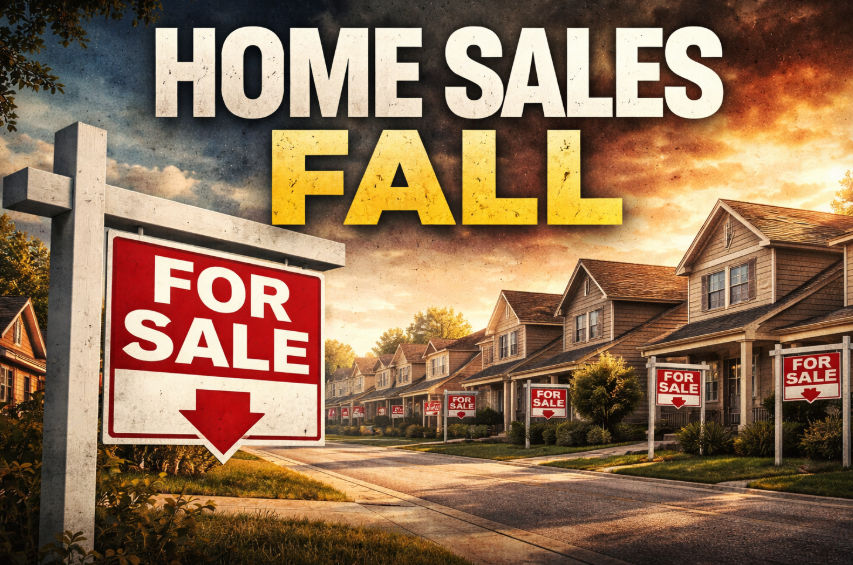
U.S. home sales fell sharply in January, underscoring ongoing struggles in the housing market and the growing challenge many American families face in pursuing the traditional dream of homeownership.
As reported by CNBC, sales of previously owned homes dropped 8.4% in January, falling to a seasonally adjusted annual rate of 3.91 million units, the lowest pace in more than two years. The decline marked the steepest monthly drop in nearly four years and came in well below economists’ expectations.
The figures, compiled by the National Association of Realtors, reflect contracts that were largely signed in late 2025, when mortgage rates were still elevated and many potential buyers were hesitant to make major financial commitments.

While mortgage rates have gradually eased compared with last year, the improvement has not been enough to offset the deeper structural pressures squeezing American households. Home prices remain near record highs, and limited housing inventory continues to keep prices elevated. The median home price reached $396,800 in January, extending a streak of more than two years of annual price increases.
At the same time, the housing market is still contending with the consequences of years of underbuilding, higher borrowing costs, and lingering economic uncertainty. The inventory of unsold homes stood at about 1.22 million properties, representing only a 3.7-month supply at the current sales pace—well below the roughly five to six months typically considered a balanced market.
For many first-time buyers, these conditions have placed homeownership further out of reach. First-time buyers accounted for just 31% of purchases in January, well below the roughly 40% share economists generally view as healthy for a functioning housing market.
Homes are also sitting on the market longer. The median time a home remained listed rose to 46 days, up from 41 days a year earlier, suggesting that buyers are becoming more cautious as affordability pressures mount.
Some analysts pointed to severe winter weather as a factor that may have temporarily slowed activity in parts of the country. However, the broader slowdown reflects deeper economic realities.
Higher housing costs—combined with inflation, rising insurance premiums, and economic uncertainty—have made many families hesitant to take on the financial responsibility of a mortgage. Even with mortgage rates hovering near 6%, the overall cost of purchasing a home remains significantly higher than it was just a few years ago.
For generations, homeownership has been central to the American vision of stable families, thriving communities, and financial stewardship. Yet the latest housing data reveals how difficult that path has become for many young families seeking to establish roots and build long-term stability.
Economists say the coming spring home-buying season will be an important test. If inventory rises and borrowing costs ease further, activity could improve. But without meaningful relief in housing supply and affordability, many Americans may find the dream of owning a home delayed for yet another year.