A former senior official tied to the nation’s pandemic response is now facing serious federal charges, raising renewed concerns about transparency and accountability during one of the most critical periods in recent American history.
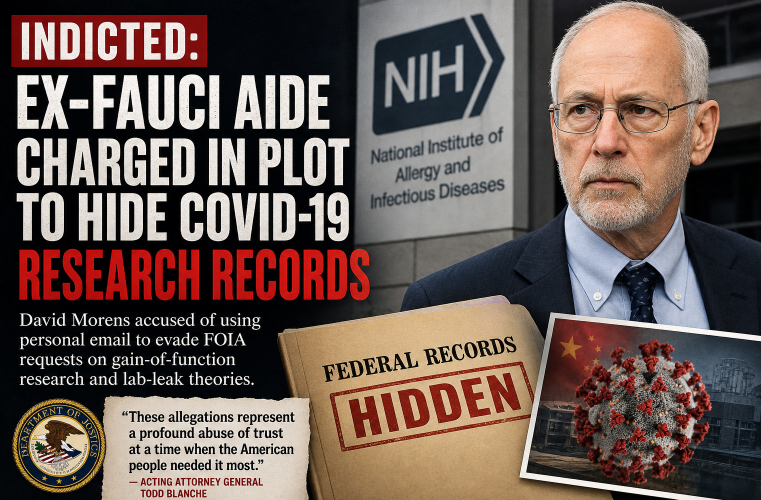
A federal grand jury in Maryland has indicted David Morens, a longtime adviser to former National Institute of Allergy and Infectious Diseases director Anthony Fauci. The indictment, unsealed this week, alleges that Morens conspired with others to conceal federal records related to research on viruses similar to COVID-19.
According to the charges, Morens faces five counts, including conspiracy against the United States, falsifying or destroying records tied to federal investigations, and deliberately concealing official documents. Prosecutors claim that between 2020 and 2022—at the height of the global pandemic—Morens used personal email accounts to evade Freedom of Information Act (FOIA) requests seeking communications about sensitive research.

Those requests came from multiple watchdog and research organizations, including Judicial Watch and the Heritage Foundation, as they sought greater clarity on government-funded studies and the origins of the virus.
The indictment includes excerpts of emails in which Morens allegedly discussed ways to avoid disclosure. In one message from February 2021, he reportedly wrote that he had “learned… how to make emails disappear.” In another, he suggested his personal Gmail account was beyond the reach of FOIA scrutiny.
The communications in question involved exchanges with prominent figures connected to pandemic-era research, including Peter Daszak and Gerald Keusch. Both had professional ties to federally funded research initiatives, including studies examining coronavirus origins and controversial “gain-of-function” experiments—research that can involve enhancing viruses to study their transmissibility or severity.
The issue of “gain-of-function” research has remained a point of intense debate, particularly as questions persist about whether the COVID-19 pandemic originated from natural transmission or a potential laboratory incident. While organizations like the World Health Organization have maintained that animal-to-human transmission is the most likely explanation, others—including officials from the Trump administration—have pointed to the Wuhan Institute of Virology as a possible source.
In a statement following the indictment, Acting Attorney General Todd Blanche described the allegations as a “profound abuse of trust,” emphasizing that the American people deserved honesty during a time of global crisis. FBI Director Kash Patel echoed that sentiment, underscoring the seriousness of attempts to suppress information tied to the pandemic’s origins.
Morens is scheduled to appear in court for arraignment on May 8. His attorney has declined to comment on the charges.
The case adds to a broader reckoning over how information was handled during the COVID-19 crisis. At stake is not only the integrity of public health institutions but also the foundational principle that truth should not be obscured—especially in moments when lives hang in the balance.
From a moral perspective, the allegations serve as a sobering reminder of the consequences of secrecy and deception in positions of authority. Scripture teaches that “whoever walks in integrity walks securely, but whoever takes crooked paths will be found out” (Proverbs 10:9). In a time when trust in institutions has been deeply shaken, the pursuit of truth and accountability remains essential.
As this case unfolds, it may further illuminate what happened behind closed doors during the pandemic—and whether those entrusted with public responsibility upheld that trust or worked to conceal it.