
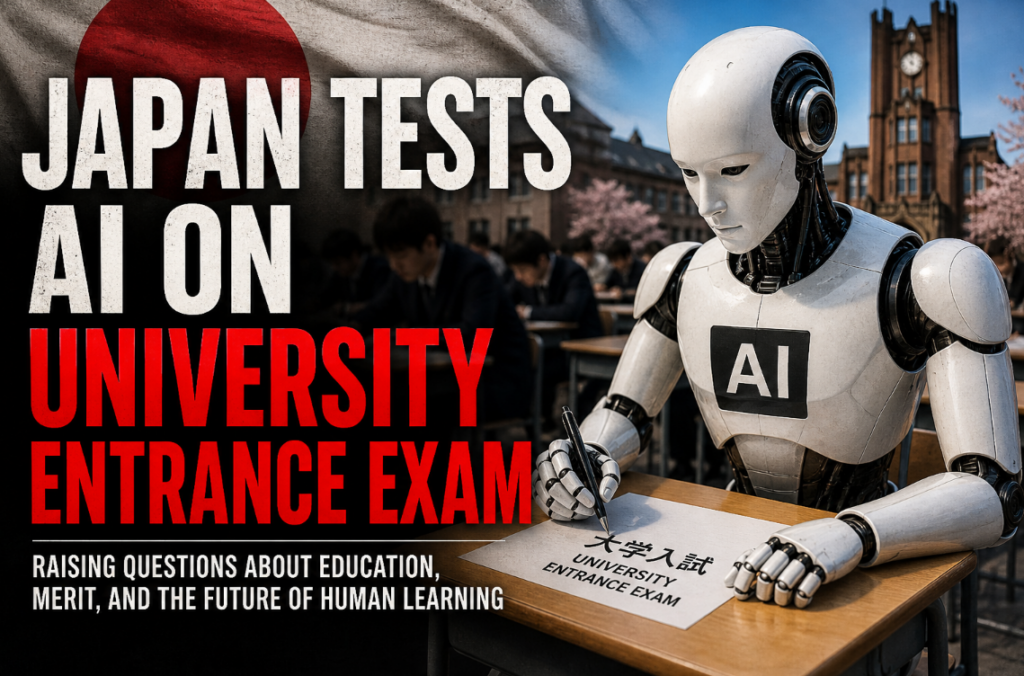
Japan is once again at the forefront of technological innovation, but its latest development is raising deeper questions about the future of education, human intellect, and the role of artificial intelligence in society. As reported by The Japan Times, researchers have tested advanced artificial intelligence systems on the country’s notoriously difficult university entrance exams—with striking results.
According to the report, AI models demonstrated the ability to perform at levels comparable to, and in some cases exceeding, human students on portions of the standardized tests. These exams, long considered a rigorous measure of academic merit and discipline, are a gateway to Japan’s most prestigious universities. The fact that machines can now approach or surpass this benchmark signals a profound shift.
Researchers emphasized that the AI did not simply memorize answers but applied reasoning across subjects like mathematics and language. While limitations remain—particularly in nuanced comprehension and open-ended responses—the trajectory is clear: machines are rapidly closing the gap.

This development highlights a growing tension in modern society. For generations, academic testing has been viewed as a reflection of diligence, intelligence, and personal responsibility. Yet the rise of AI challenges that framework. If a machine can outperform a student who has spent years studying, what does that say about the value of human effort?
From a broader perspective, this moment underscores the risks of placing too much trust in human-created systems while neglecting the God-given capacity for wisdom, discernment, and moral reasoning. Education, at its core, has never been solely about information recall—it is about forming character, cultivating truth, and preparing individuals to live responsibly before God and society.
The increasing reliance on AI tools also raises concerns about fairness and integrity. If such systems become widely accessible, the temptation to use them as shortcuts could undermine the principle of honest work. In a culture already struggling with relativism and declining standards, the normalization of AI-assisted performance may accelerate the erosion of merit-based achievement.
At the same time, proponents argue that AI could serve as a tool to enhance learning, offering personalized instruction and expanding access to knowledge. However, tools are never neutral; they reflect the values of those who design and deploy them. Without a moral foundation rooted in truth, even the most advanced technology can lead to unintended consequences.
Japan’s experiment serves as a warning as much as it does a milestone. The question is no longer whether AI can match human intelligence in certain domains—it increasingly can. The more pressing question is whether society will preserve the unique dignity and responsibility of human beings, created with purpose and moral agency.
As the line between human and machine capability continues to blur, the future of education—and indeed civilization—may depend on whether we remember that true wisdom does not come from algorithms, but from a higher source.