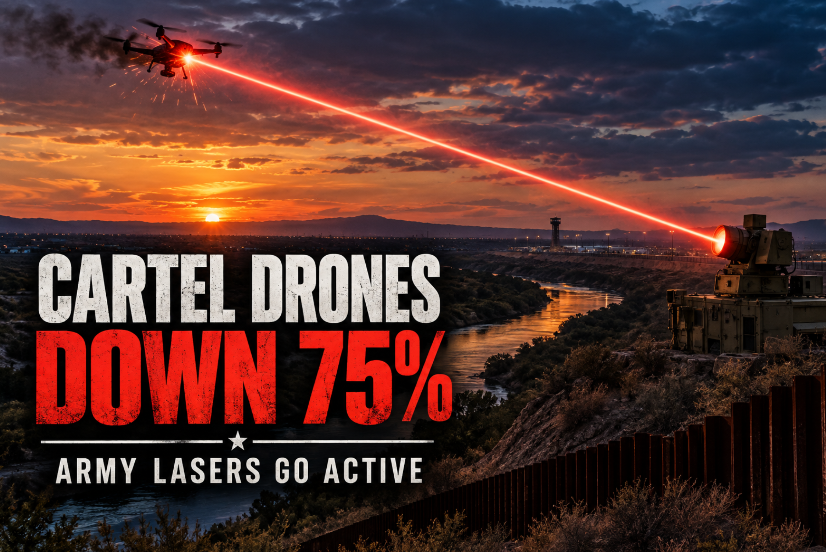
Suspected cartel-linked drone activity over the Rio Grande Valley has reportedly plunged by roughly 75 percent following the deployment of a U.S. Army high-energy laser system along the southern border, marking a significant development in efforts to defend American territory from increasingly sophisticated cartel surveillance.
As reported by The Gateway Pundit, Customs and Border Protection sources said the directed-energy system has proven highly effective against unmanned aircraft believed to be connected to Mexican cartels. The report, citing The Hill, said the laser can completely disable targeted aircraft rather than merely disrupt their communications.
Before the laser’s deployment, American forces largely relied on electronic warfare equipment to jam suspected cartel drones. That approach presented an obvious limitation: If operators succeeded in overcoming the interference, their aircraft could potentially return to service. A laser that physically disables a drone changes that equation by taking the aircraft out of operation altogether.

The Army purchased the high-energy laser system in 2025 while developing scalable directed-energy capabilities for countering unmanned aircraft and other aerial threats. The system was fully integrated into the Army’s layered border-defense network in August 2026, according to the report.
Pentagon and U.S. Northern Command figures cited in the report indicate that Joint Task Force–Southern Border stopped more than 300 drones associated with illicit activity during the first eight months of 2026. More than 100 were stopped in August alone. NORTHCOM said the Army Multipurpose High-Energy Laser entered operational use on August 24 and had defeated 11 drones by September 4.
Gen. Gregory Guillot, commander of U.S. Northern Command and NORAD, said frontline troops have the necessary authorities and a capable network for countering threats to forces carrying out the territorial-integrity mission.
Cartels reportedly use small drones to monitor Border Patrol agents and military personnel and help coordinate smuggling operations. Such activity illustrates how border security is no longer simply a matter of fences and patrol vehicles. Criminal organizations can exploit inexpensive technology to watch American personnel from the air and potentially gain an operational advantage.
A government entrusted with defending its citizens has a fundamental obligation to secure the nation’s territory and uphold the rule of law. From a Christian understanding of civil authority, government bears a legitimate responsibility to restrain wrongdoing and protect the innocent. Effective technology cannot substitute for sound border policy, but when properly employed under lawful authority, it can give American personnel another means of confronting criminal organizations that challenge the nation’s sovereignty.
The reported 75-percent decline suggests that confronting cartel capabilities directly can produce measurable results. The challenge now will be determining whether those gains endure as criminal organizations adapt their tactics and technology.