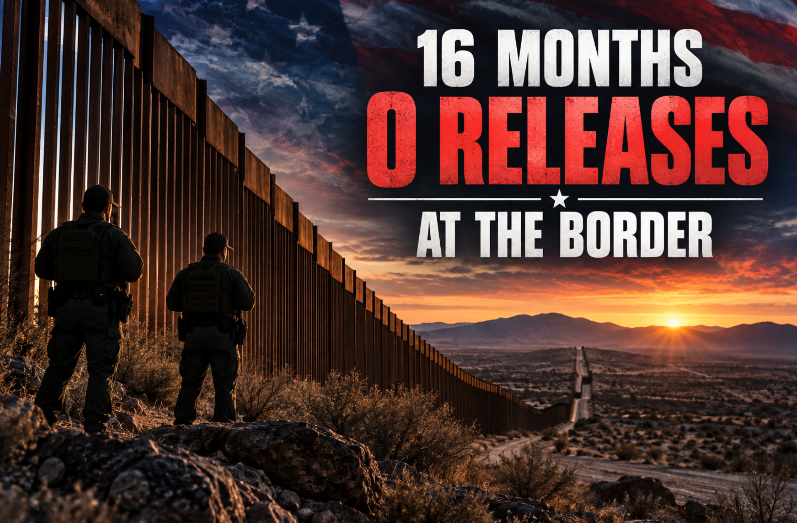
President Donald Trump’s administration is marking 16 consecutive months with no releases at the U.S.-Mexico border, according to the Department of Homeland Security and U.S. Customs and Border Protection.
As reported by Fox News, DHS and CBP announced the milestone Wednesday, saying the administration’s enforcement policies have ended the practice commonly known as “catch and release.”
DHS Secretary Markwayne Mullin said the streak demonstrates that the administration’s border policies are producing results. He said illegal crossings have fallen to what the department described as historic lows and argued that the government has restored consequences for unlawful entry. CBP Commissioner Rodney Scott similarly said the agency’s current standard is to apprehend, detain and remove individuals who cross illegally rather than release them into the United States.

According to U.S. Border Patrol data cited by Fox News, agents apprehended 8,870 people along the Southwest border in August, down 5 percent from July. DHS said that figure was 94 percent lower than the average monthly total recorded during former President Joe Biden’s administration. The department also reported zero parole releases in August, compared with more than 10,000 releases in August 2024.
The administration has also pointed to increased drug seizures as part of its broader border enforcement effort. DHS said fiscal-year drug seizures were up 73 percent compared with the same period in 2024, while seizures were 61 percent higher than the average of the previous four years. Cocaine seizures reportedly rose 28 percent in August to 6,724 pounds, while CBP and ICE seized more than 120,000 pounds of precursor chemicals that month.
The reported decline in releases and illegal crossings comes as the administration continues expanding physical border infrastructure. In Arizona, construction has begun on a section of border wall as part of a broader $46 billion program involving 30-foot steel bollards, vehicle barriers and surveillance technology.
That construction has also faced legal opposition. The Tohono O’odham Nation challenged the project, arguing that it could damage land the tribe considers sacred. A federal judge rejected the tribe’s argument in the case cited by Fox News, noting that the planned construction would remain within the federally owned Roosevelt Reservation.
The administration’s broader message is that strict enforcement, detention and removal policies have changed conditions at the southern border. Supporters of that approach argue that a sovereign nation has an obligation to know who is entering its territory and to enforce its immigration laws consistently. Critics continue to challenge parts of the administration’s enforcement strategy in court and through public opposition.
For Americans concerned with public order, border security and the government’s duty to enforce the law, the latest DHS figures will likely become a central part of the ongoing national debate over immigration policy.